Bars, profiles, tubes, extrusions, rails, beams. Materials that fill cantilever racking every day, take up entire aisles, require lifting equipment, increase injury risks and consume time that is never recovered.
If your company handles long goods, you already know the scene: an operator searching for the right profile among dozens of stacked units, a forklift maneuvering in tight spaces, a delivery waiting while ten minutes disappear somewhere in the warehouse.
“Long goods storage is one of the most underestimated operational bottlenecks in industrial intralogistics. Not because it is uncommon — it is widespread — but because businesses have simply learned to manage it poorly.“
This article explains why vertical automation can substantially change the way bars, profiles and long materials up to 7 meters are handled — and why not every automated system solves this problem in the same way.
The real cost of traditional long goods storage
Traditional solutions for storing long goods — cantilever racking, ground-level storage, manual systems — share a common trait: they work as long as volume is low and variety is limited.
When the number of SKUs grows, when production speeds up, when shifts change or different operators are involved, the system starts to break down. The costs are not always visible in a single budget line, but they accumulate across multiple inefficiencies:
- High search and retrieval time, especially across wide assortments of profiles and bars
- Suboptimal use of floor space, with handling aisles reducing available productive area
- Injury risk during the handling of heavy and bulky loads
- Material damage from impact, scratching or deformation caused by poor storage
- Lack of inventory control: no clear visibility of what is stored, where, and in what quantity
- Difficulty integrating with downstream production flows, causing idle time and delays
These are not marginal issues. They are operational costs that repeat every day, on every shift, for every operator who enters the warehouse.

Vertical automation for long goods: what actually changes
An automated vertical storage system for long goods is not simply a motorized rack. It is a system that reorganizes the way materials arrive, are stored, are located and are retrieved.
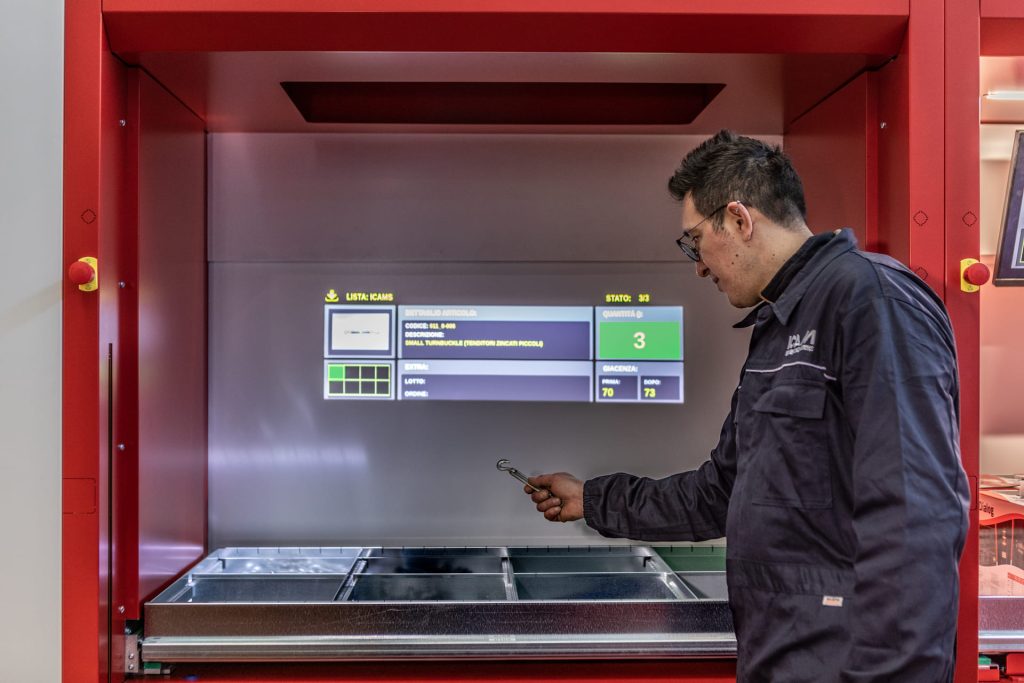
The core principle is the same as for automated vertical storage systems handling small parts and components: the material comes to the operator, not the other way around. Every load unit is automatically extracted and brought to the picking/refilling station. The operator does not move, does not maneuver, does not search.
In the long goods domain, however, there are specific requirements that a system must be able to handle:
Load capacity and length
Long goods combine bulk and weight in a way that standard solutions do not address. Profiles and bars can reach lengths of 6 to 7 meters, with load weights per tray exceeding 1,000 to 3,000 kg. The system must be designed for this category of material, not adapted to it after the fact.
Safe loading and unloading
The loading phase is often as critical as retrieval. When materials arrive from outside the facility — on trucks, in bundles, on flatbeds — the initial handling is the moment of highest operational risk. A system designed for this requirement must be able to manage external loading without forcing complex internal maneuvering.
Integration with the production flow
Long goods are rarely a final destination: they are inputs for processing. Retrieval speed and inventory traceability directly affect the continuity of the production cycle. A delay in the warehouse almost always translates into a machine stoppage downstream.
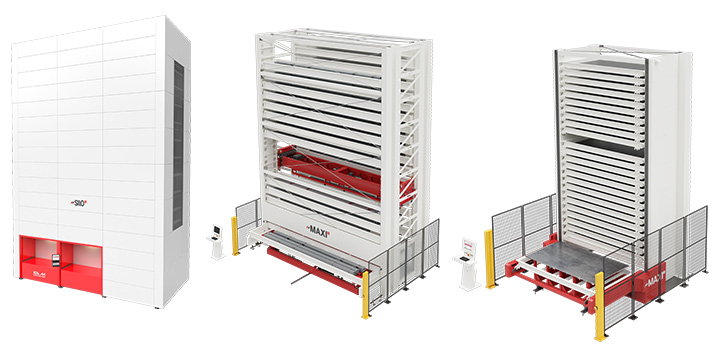
MAXIᴸ: the ICAM automated vertical storage system designed for long goods up to 7 meters
MAXIᴸ is the ICAM solution for the automated storage of long goods: profiles, bars, tubes, extrusions, shafts, rails and similar materials. It is not an adapted version of a product designed for something else: it is a system conceived specifically for the needs of those who handle this type of material every day.

Real load capacity for real loads
MAXIᴸ trays carry up to 3,000 kg, with a base configuration of 1,000 kg. This means the system is built to work every day with bundles of heavy bars, structural profiles and thick-walled tubes — in continuous production, without compromise.
Lengths up to 7 meters
The system is designed to handle materials up to 7 meters in length, covering the vast majority of standard profiles used in window and door manufacturing, metalworking, structural steelwork and the processing of aluminum or PVC extrusions.
The motorized shuttle: the operational breakthrough
One of the most significant features of MAXIᴸ is the motorized shuttle for tray loading and unloading. This element substantially changes the logistics of the entire facility.

Thanks to the shuttle, material can be loaded directly from the external yard, with no need for complex internal handling. The forklift operates in the perimeter loading zone; the shuttle manages insertion into the system. Internal operators are not exposed to loading operations, internal traffic is reduced, and risk is significantly minimized.
“You are not just automating storage. You are redesigning how materials enter your facility — and eliminating one of the highest-risk moments in your daily operations.“
Vertical development, floor space recovered
Like all automated vertical storage systems, MAXIᴸ uses available height rather than horizontal footprint. The floor space previously occupied by cantilever racking or ground-level storage is freed up and made available for high-value production or logistics activities.
Scalability in height: the system grows with your business
MAXIᴸ is designed to grow over time without requiring a complete replacement of the installation. The height of the system can be increased at a later stage by adding 500 mm modules that extend vertical storage capacity. The initial investment is not a constraint — it is a starting point. As operational needs evolve — more SKUs, higher volumes, new materials to manage — the system adapts without disrupting the layout or halting production.
You are not buying a system for today. You are building an infrastructure that can grow alongside your business, one module at a time.
Control and traceability with ICON
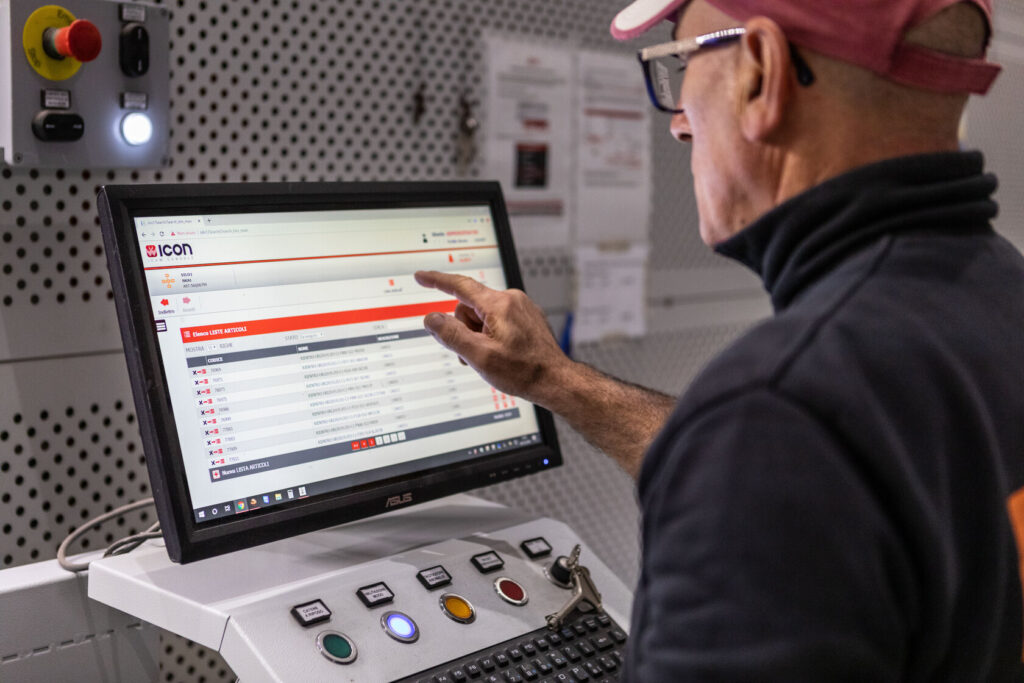
MAXIᴸ integrates with ICON, the ICAM management software that governs automation, communicates with ERP, WMS and MES systems, and makes every movement traceable and measurable. The inventory of bars, profiles and extrusions is always up to date, accessible and manageable without manual counts or spreadsheets.
“Every retrieval is recorded. Every tray knows what it holds. Every operator knows where to find what they need, in seconds.”
Who MAXIᴸ is designed for: the sectors where it makes the difference

MAXIᴸ is particularly effective in environments where the handling of long goods is critical to production continuity, and where the number of SKUs, material weight or access frequency make traditional solutions inadequate.
Window and door manufacturing, aluminum and PVC profile processing
One of the core application contexts for MAXIᴸ. Extruded aluminum and PVC profiles are central production materials: they vary by cross-section, color and length, turn over frequently and require fast, accurate retrieval. Disorganized storage generates errors, slowdowns and waste.
Service centers and distribution of metal sections
Anyone managing a wide assortment of bars, angles, UPN, HEA sections and beams knows how quickly the warehouse can become a bottleneck. MAXIᴸ makes it possible to manage high volumes of SKUs in reduced space, with guided picking and an always up-to-date inventory.
Metalworking and structural fabrication
Managing steel bars, tubes, shafts and metal semi-finished goods is critical to feeding machining centers without interruption. Material traceability and retrieval speed directly affect machine utilization rates.
Aftermarket and spare parts with long goods
Even in distribution and aftermarket contexts, the presence of shafts, rails, special profiles and rods requires a system capable of managing a wide variety of SKUs with precise retrieval. MAXIᴸ handles this type of assortment with the same effectiveness that a vertical storage system provides for small parts.
Cantilever, ground-level storage or automated storage system: how to choose
The choice between traditional solutions and vertical automation is not always straightforward. It depends on volumes, retrieval frequency, SKU variety and operational objectives. However, there are clear signals that point towards automation:
- The warehouse is frequently chaotic and search and retrieval times are high
- Dozens or hundreds of long goods SKUs with different characteristics need to be managed
- Manual handling generates injury risks or material damage
- Floor space is saturated or expensive and horizontal expansion is not available
- Inventory accuracy is consistently poor and production disruptions are a recurring issue
- There is a need to integrate the materials warehouse with an ERP or production planning system
When these signals are present, the comparison is not just between technologies: it is between the cost of continuing as today and the value of a system that performs better every day.
Frequently asked questions about automated long goods storage
Can profiles be loaded directly from the truck?
Yes. The MAXIᴸ motorized shuttle is designed exactly for this: it allows trays to be loaded in the perimeter zone of the facility, directly from the external yard, eliminating the need for internal forklift maneuvering during goods receipt.
Does it work with materials of very different weights and dimensions?
MAXIᴸ is designed to handle loads from 1,000 kg up to 3,000 kg per tray, with lengths up to 7 meters. Variation in material weight and cross-section is something the system is built to accommodate within the same installation.
Does it integrate with my ERP or WMS?
Yes. Through the ICON software, MAXIᴸ can be integrated with ERP, WMS and MES systems. This provides real-time inventory, full movement traceability and automated management of retrieval priorities.
What is the advantage over a cantilever racking system?
Traditional cantilever racking addresses the physical containment of the material, but not retrieval time, inventory control or operational risk during handling. Vertical automation addresses all three simultaneously.
Budget not yet ready for full automation? There is an ICAM alternative
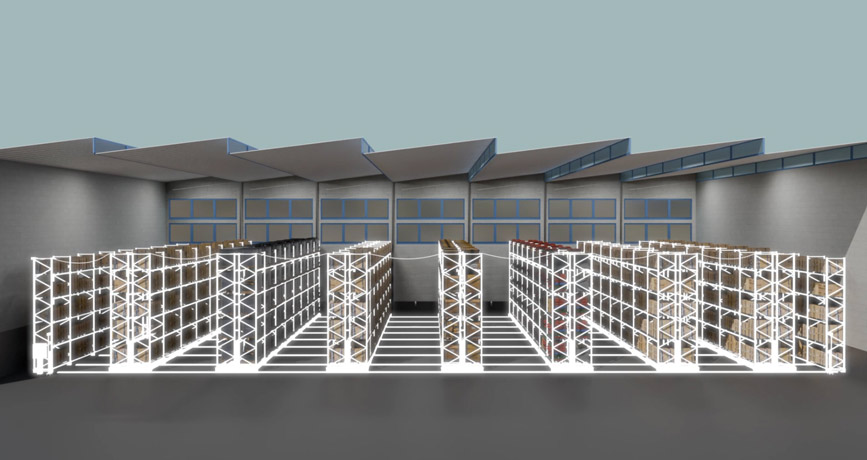
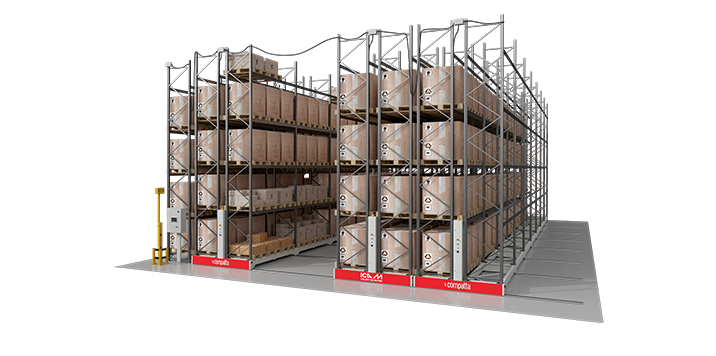
Conditions are not always right for an investment in vertical automation. If the immediate objective is to improve storage density and reduce the floor space occupied by long goods while keeping the initial investment more contained, ICAM also offers COMPATTA system with motorized mobile bases on which cantilever racking for long goods can be installed.

This solution eliminates fixed aisles between racks, significantly increasing usable floor area, while maintaining selective access that preserves order and safety. The operator opens the required aisle and retrieves the material with the forklift, exactly as with traditional cantilever racking — but in a much smaller footprint.
The strategic point is that the two solutions can coexist within the same facility: MAXIᴸ for the highest-turnover or operationally critical materials, and COMPATTA system with cantilever racking for lower-frequency SKUs or areas where vertical automation is not yet a priority.
“This is not a choice between automation and manual handling: it is intelligent space design — placing the right technology in the right place, based on operational priorities and available investment.”
How others have already solved the problem
MAXIᴸ is already installed in real production environments, where it has measurably changed the day-to-day management of bars, profiles and extrusions. The most significant results relate to reduced retrieval times, recovered floor space, eliminated inventory errors and improved operational safety during loading.
Read the user story: how Tempragas transformed long goods storage with MAXIᴸ
Want to find out if MAXIᴸ is the right solution for your warehouse?
Every facility is different: material type, volumes, available layout, production flows. Before any decision, a concrete analysis of the context is the right starting point.
The ICAM team works alongside businesses from the analysis phase through to installation and ongoing management, with a design approach that always starts from real operational problems, not standard configurations.
Explore MAXIᴸ: technical specifications, configurations and applications
Request a consultation: let’s talk about your warehouse