In the Ho.Re.Ca. channel, the warehouse is never just a back-end operation. It is where the promise made to the customer — quality, precision, reliability — is either kept or broken. Yet for many beverage distributors, premium stock management still relies on traditional racking, relying on operator experience and visual identification. Until the error rate becomes impossible to ignore.
The paradox of premium beverage distribution
Distributing fine wines, champagnes and rare spirits to the hospitality industry creates a clear operational challenge: the higher the assortment level, the greater the risk of error. A Brunello di Montalcino and a Chianti Classico share similar packaging. A Japanese single malt and a Scottish one differ in details that, under operational pressure, are easily missed.
In a context that promises delivery within 12 hours, handles 160 to 250 orders a day and processes orders including over 200 different SKUs in a single shipment, any mistake has an immediate and measurable cost.
That cost is not only financial — a 100-euro bottle delivered to the wrong customer, or not delivered at all. It directly affects brand perception. In the premium segment, an error is not experienced as a simple operational slip: it is read as a mismatch between product quality and service quality.
L.P. Distribuzione Bevande: fast growth, rising complexity
L.P. Distribuzione Bevande — Lo Presti Domenico & C. S.A.S. — is a Sicilian company with nearly fifty years of history, now run by the second generation of the founding family.
Its catalogue spans over 4,000 SKUs — approximately 1,500 spirits, more than 500 wine and sparkling wine labels, plus beers, soft drinks and food — served to hotels, restaurants and bars with a guaranteed delivery window of 12 hours from order receipt, with no exceptions, even during summer peaks.

Since relocating to its new facility in Aci Sant’Antonio in 2022, the number of references has doubled in under two years. Strong commercial growth — but also greater variability, more products with similar packaging, and a higher risk of confusion, particularly in the high-value tier where errors are least tolerable.
The real problem was not space, it was control
The picking error rate stood at around 1%. That figure may appear low, but in a warehouse handling 160 to 250 orders per day it translated into daily corrections, verifications, rework and a constant slowdown in operations.
Fragile items — temperature-sensitive wines, crystal bottles, rare labels — were also exposed to dust and temperature fluctuations that compromised their condition at the point of delivery.
The root cause was structural: products with similar packaging, managed by operators relying on visual memory. In the premium tier, product quality and process quality cannot be decoupled.
The solution: a SILO² vertical warehouse dedicated to what matters most
The decision was precise: not to automate the entire warehouse, but to create a dedicated system for the most sensitive and strategically important references — one that reflects their positioning.

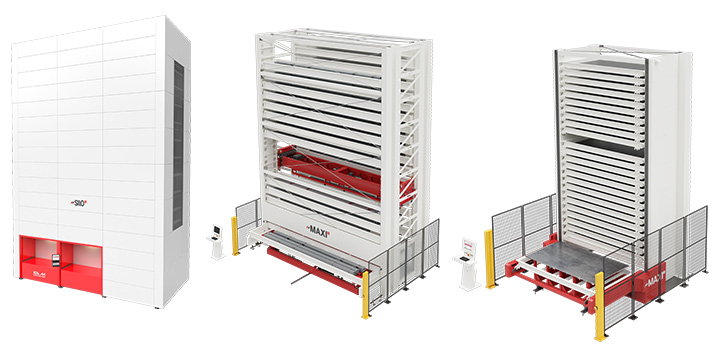
The ICAM SILO² vertical automated warehouse was installed at the end of the picking route: operators complete picking across the rest of the warehouse and complete each order at the vertical unit, where high-value references are retrieved.
An integration into the flow, not a disruption of it.
Insulation as a quality standard
The SILO² installed at L.P. Distribuzione is insulated, maintaining optimal conservation conditions for the most delicate references. For fine wines and champagnes, cold chain continuity is not an added feature — it is an integral part of the quality of the product delivered to the end customer.
Guided identification that eliminates visual ambiguity
With a capacity of 2,200 six-bottle cases, the unit currently holds approximately 900 references at 70% utilisation. Tray allocation is designed to minimise confusion between products with similar packaging: every reference has an assigned position, not an arbitrary one.
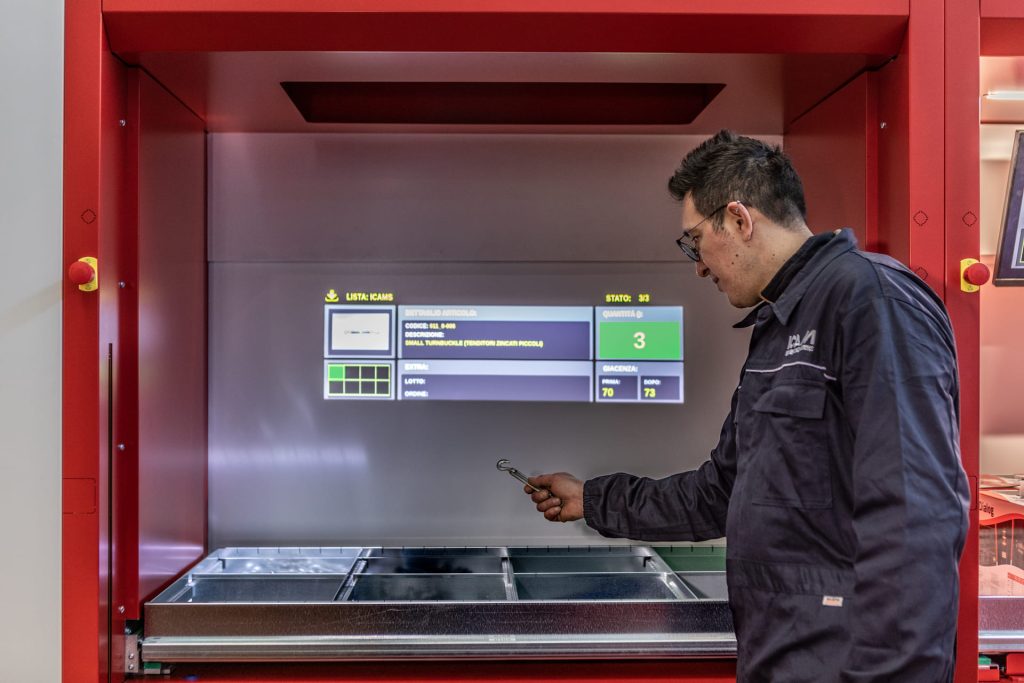
The IRIDE light-directed picking system guides the operator unambiguously — the correct reference is indicated without room for doubt. No label comparison, no interpretation: just retrieval.
Integration with existing business systems
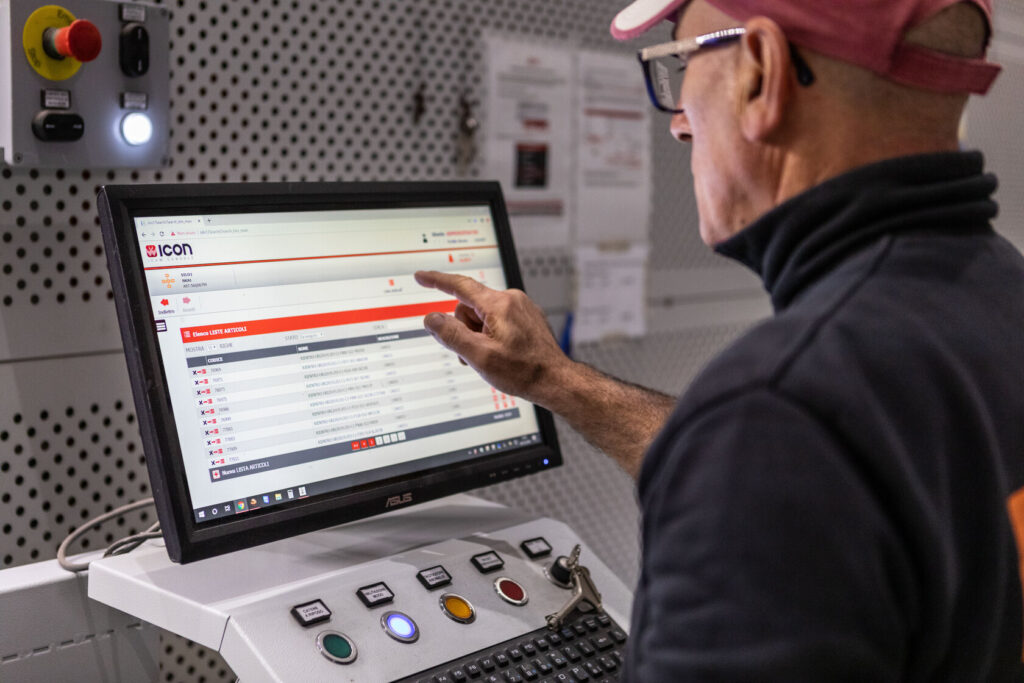
The system is fully integrated with the Stocksystem WMS and Zucchetti’s Bollicine ERP, providing real-time visibility and traceability. FIFO and EDD logic ensure correct product rotation without manual intervention.
The installation by the numbers
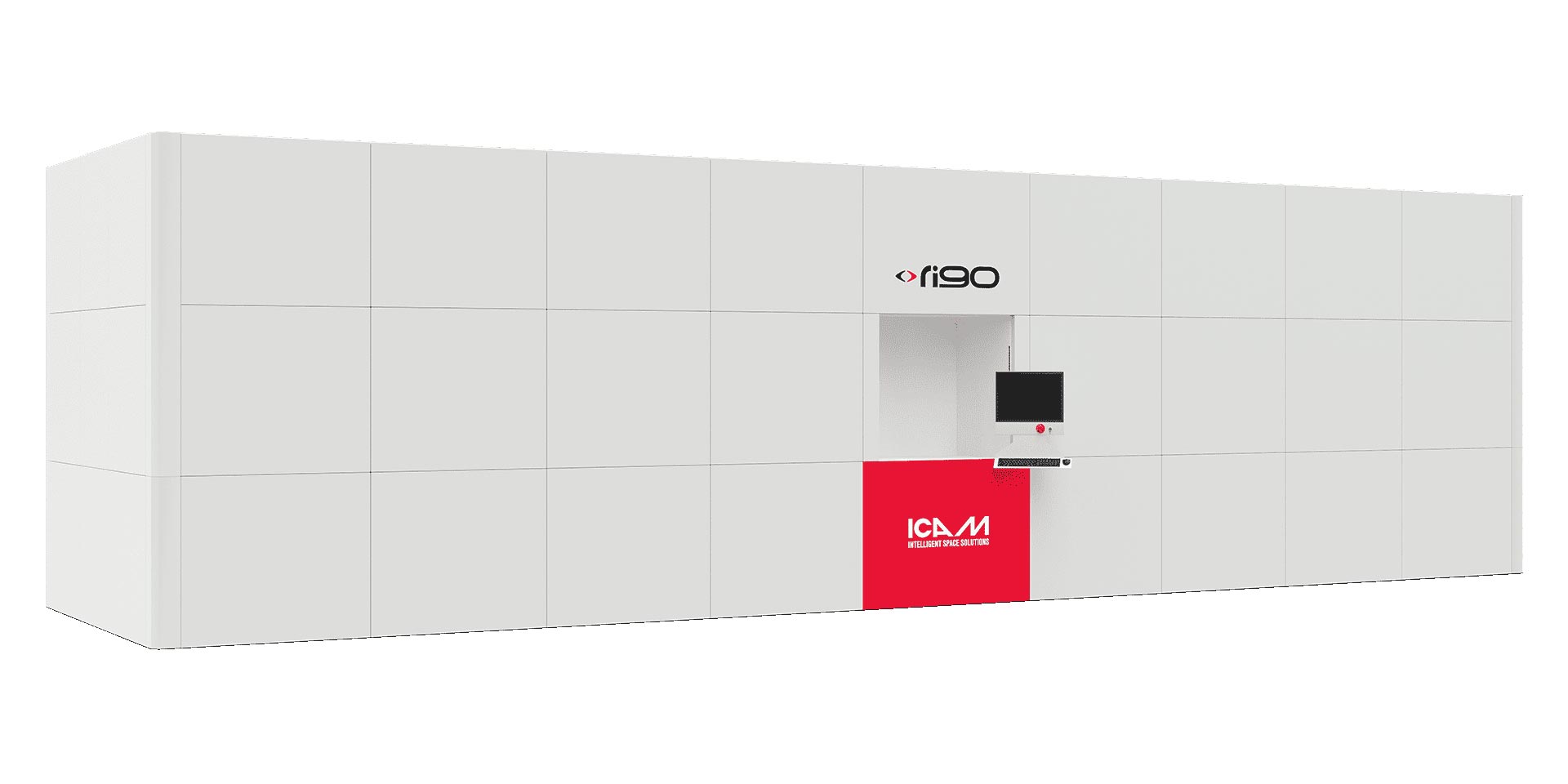
The SILO² installed at L.P. Distribuzione rises to 10.1 metres, making full use of the available ceiling height at the Aci Sant’Antonio facility to achieve a storage capacity on a footprint of just 23 square metres.

The unit is 7 metres wide and approximately 3 metres deep at the base: dimensions that allow it to be integrated into the picking route without altering the layout of the surrounding areas.
Internally, the machine is organised across 3 storage columns with 124 trays, each measuring 1,953 x 802 mm with a usable load height of 375 mm. Total volumetric capacity reaches 72.83 m³, equivalent to 194.22 m² of storable surface area.
The two picking/refilling stations — both equipped with automatic roller shutters and the IRIDE light-guided picking system — enable guided, safe picking and storage, with FIFO and EDD logic governing correct reference rotation throughout.
The results: from 1% to 0.02% error rate
In approximately ten months of operation, the SILO² has handled over 2,300 picks. Errors recorded: two. Both were attributable to operator distraction during a phone call, not to the system.
The comparison with the previous figure is unambiguous: from 1% to 0.02%. From one error per hundred picks to two errors per two thousand. In operational terms, this means virtually eliminating corrections, returns, rework and their downstream impact on customer satisfaction.
The 120 square metres freed from traditional racking were not simply cleared: they were repurposed to support further assortment growth. Verticalisation improved the warehouse’s volumetric utilisation coefficient, creating real headroom to keep growing without compromising the 12-hour fulfilment promise.

What this story tells the sector
There is a lesson here that extends beyond this specific case. The average value of bottles stored in the SILO² is around 100 euros. Keeping these references in an automated, insulated and organised system is not merely an operational choice — it directly reflects the consistency between what is sold and how it is handled.

The signals that tell you it is time to consider automation
The L.P. Distribuzione experience is a replicable model. The signals that indicate the moment to evaluate an automated system has arrived are recognisable:
- The picking error rate on premium references is growing alongside the assortment
- Products with similar packaging generate recurring confusion, even among experienced operators
- Delicate references are stored without controlled conservation conditions
- The assortment is growing but the physical space and the process cannot keep pace
- There is a visible gap between the quality of the products offered and the perceived quality of the logistics process
When these signals accumulate, the answer is not to optimise the racking layout. It is to change the logic by which the tier that matters most is managed.
Want to find out whether your beverage warehouse is ready to make the same leap?
Tell us about your context: assortment, flows, critical references. We will analyse together where automation can create real value — not just operational efficiency, but consistency of positioning.