
Every company operates within a unique space and process configuration. Businesses facing limited indoor space or complex plant layouts often struggle to find storage systems that align with their workflow. Choosing the right vertical storage solution is not just about automation—it’s about maximizing capacity, minimizing operational costs, and integrating seamlessly into modern factory ecosystems. In this in-depth guide, we compare traditional single-column vertical lift modules with ICAM’s advanced multi-column SILO² VLM, highlighting why multi-column VLMs deliver greater value for companies seeking scalable, cost-effective storage with maximum space efficiency.
Multi-Column VLM vs. Single-Column VLMs: key differences
A single-column VLM consists of a single vertical storage column, where trays or bins are moved vertically to bring products to operators, following the “goods-to-person” principle.
Unlike single-column systems, multi-column VLM such as ICAM’s SILO² can be configured with multiple storage columns (from 2 to 7), offering greater adaptability to available spaces and a better price-to-storage capacity ratio (€/m³). Composed of trays arranged in opposite storage columns, they operate on the “goods-to-person” principle thanks to a lift that automatically picks up and deposits trays with the necessary items and delivers them directly to operators at the Picking/refilling stations.
Let’s explore in this article the key differences between the two vertical storage systems.
1. Cost efficiency per cubic meter: multi-column means lower investment per capacity
While both VLM types leverage vertical space, the multi-column configuration offers a significantly lower €/m³ ratio. The reason lies in how automation costs are distributed. In single-column systems, each VLM requires its own lift, motor, control unit, and software. In contrast, SILO² consolidates these functions across multiple columns within a single machine.
Concrete Example
In a comparative setup:
- 3 SILO² systems (2 tri-column + 1 bi-column) offer 493.12 m² of usable storage
- 3 single-column VLMs offer only 459.66 m²
- Result: +7,2% more storage within a similar footprint (46.2 m² single-column VLM vs. 49.5 m² multi-column VLM)
In real terms, this means fewer machines, less infrastructure, and lower operating and maintenance costs. The shared automation also simplifies troubleshooting and future upgrades.
2. Configurability and adaptability to layout: SILO² fits where others VLMs can’t
One of SILO²’s most distinctive advantages lies in its modular and scalable architecture. The system supports configurations from 2 to 7 storage columns and up to 8 picking/refilling stations, which can be positioned on opposite sides of the machine or even across different building levels.
This versatility enables SILO² to adapt to unique plant requirements, serve multiple departments simultaneously, and evolve as storage needs grow—without replacing the entire system.
Real Use Case – Regie Auto:
This automotive parts company needed simultaneous access to inventory from two different departments — mechanical workshop and spare parts sales. SILO² was configured with two opposite picking/refilling stations, one in each department. Both teams access the same inventory from different locations, with no workflow interruptions and zero redundancy.
In real terms, this means fewer machines, less infrastructure, and lower operating and maintenance costs. The shared automation also simplifies troubleshooting and future upgrades.
Explore Regie Auto case study >>
3. Efficient use of angular space
SILO² adapts to U-shaped layouts
This setup makes it possible to fully exploit corner zones, reduce the number of access points needed, and consolidate workflows. A single operator can manage an extensive inventory without covering long distances, improving both efficiency and picking times — something single-column systems, each requiring dedicated access, can’t offer.
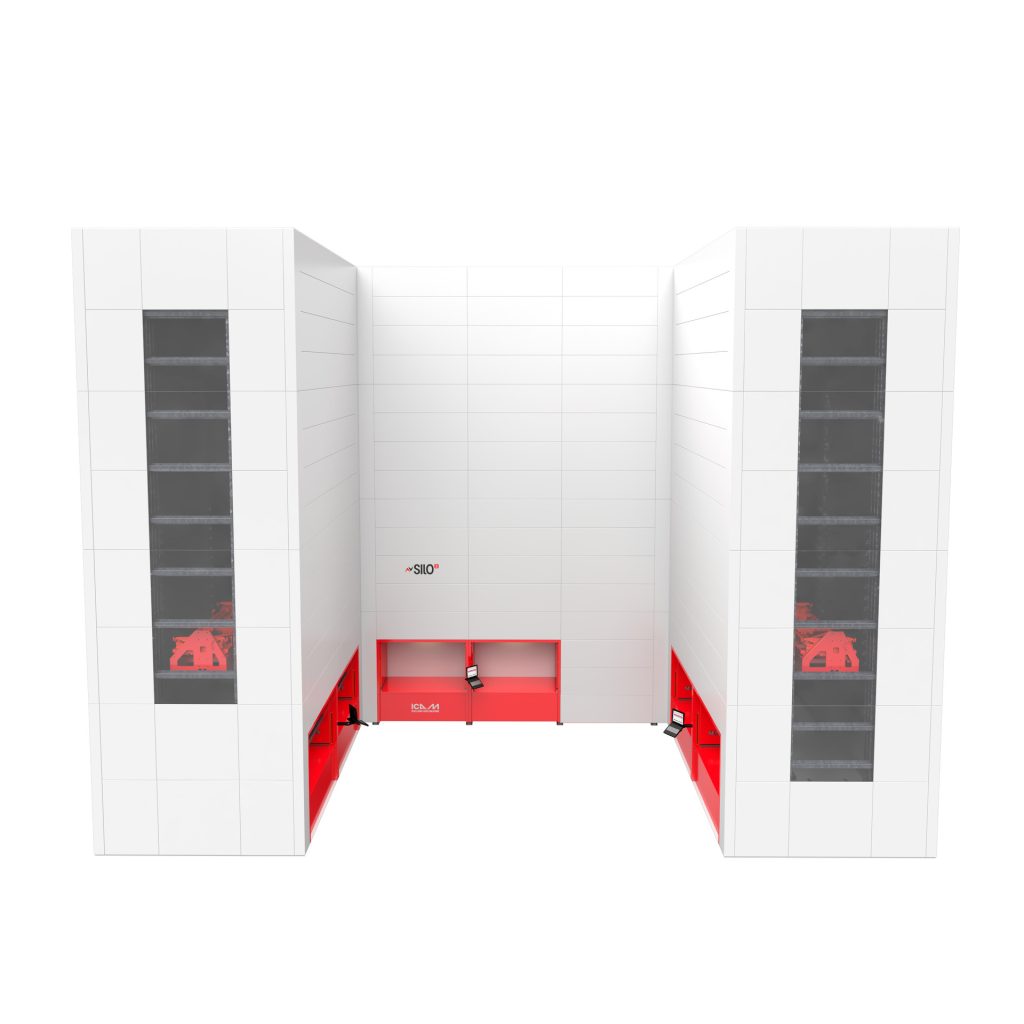
In a direct comparison:
- 3 SILO² systems (2 tri-column + 1 bi-column) offer 628 m² of usable storage capacity
- 3 single-column VLMs offer only 459.66 m²
- Result: +41% more storage within a similar footprint
4. Outdoor installation to free up indoor production space
Many businesses face space constraints that limit indoor warehouse expansion. ICAM’s SILO² can be installed outdoors with a single indoor-facing picking station, allowing companies to reclaim valuable production space.
Real Use Case – Pennellificio Bulova:
This manufacturer installed a multi-column SILO² outdoors, creating only one wall opening into the facility. The entire inventory is accessed through that single interface, significantly reducing building modifications.
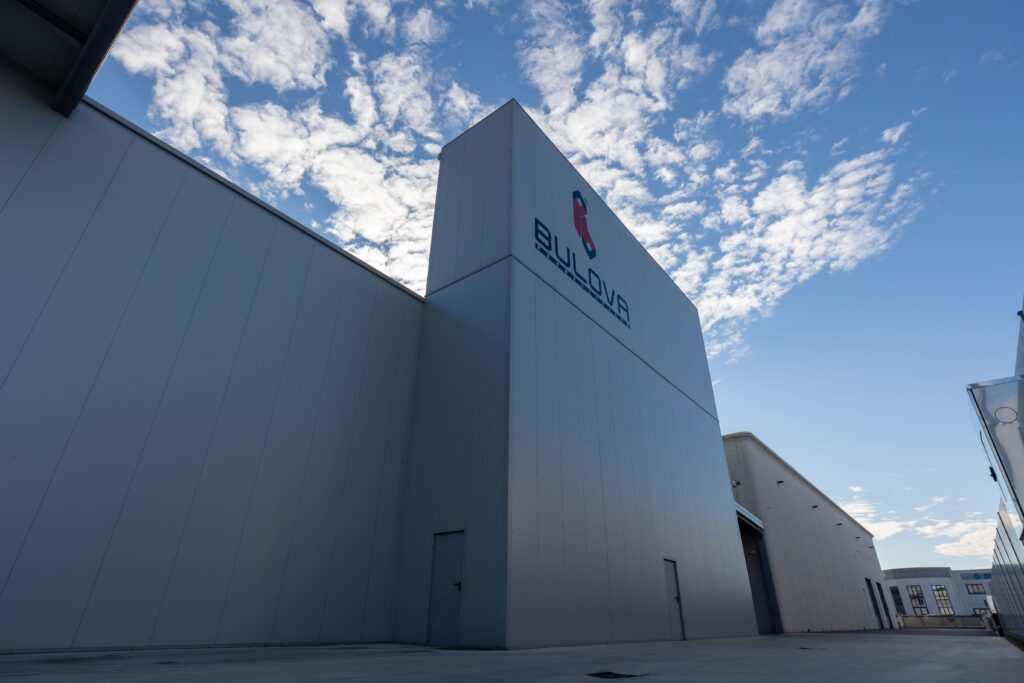
Explore the Pennellificio Bulova case study >>
Technical comparison:
- Single-column VLMs (x3): require 3 wall openings = 14 meters of indoor disruption
- 2 SILO² units: require just 2 wall openings = 4.1 meters total
- Outcome: Lower installation cost, less downtime, and better space allocation
5. Load capacity tailored to item type
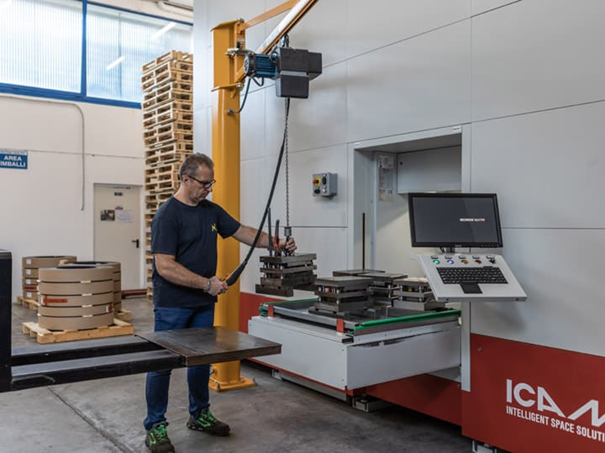
Unlike one-size-fits-all trays in single-column systems, SILO² allows custom tray load capacity, ranging from 103 to 1,001 kg/m². This makes it ideal for high-density, heavy items such as molds, dies, industrial tools, or metal parts.
By avoiding oversized trays for light loads, companies save space, reduce tray deformation (ovalization), and eliminate the need to revert to manual storage solutions for heavy goods.
6. Workflow optimization and operator ergonomics
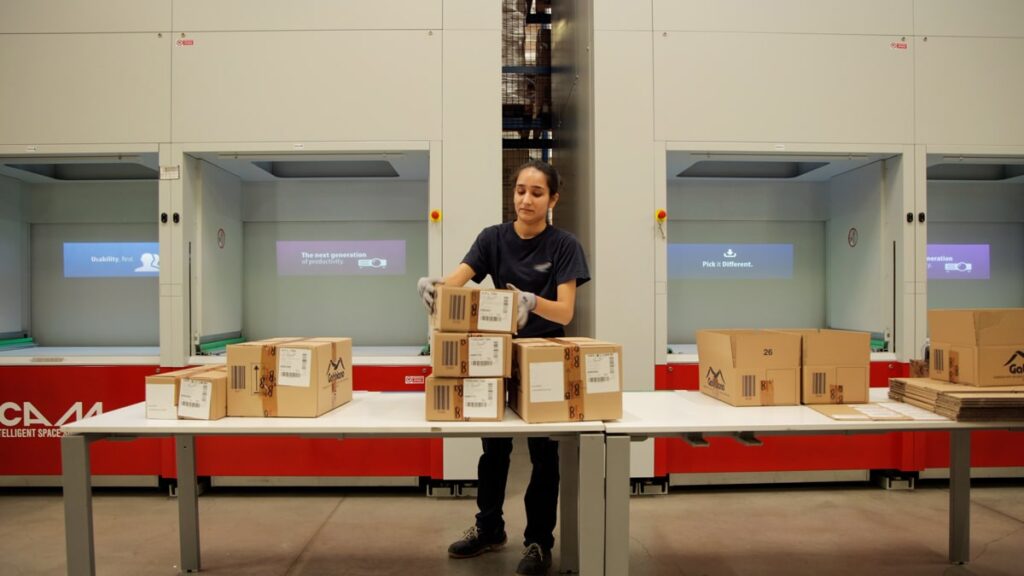
SILO² enhances both process efficiency and worker well-being. The system’s smaller, dedicated trays allow operators to retrieve only the items they need—no need to scan or handle mixed trays with irrelevant inventory. With side-by-side picking stations, operators can access the entire inventory without walking between machines. This dramatically reduces walking distances, especially in environments where time and operator fatigue directly affect output.
Additionally, SILO² offers an automatic tray extraction system for heavy or bulky materials (up to 400 kg), ensuring ergonomic handling and lifting support, reducing strain and improving workplace safety.
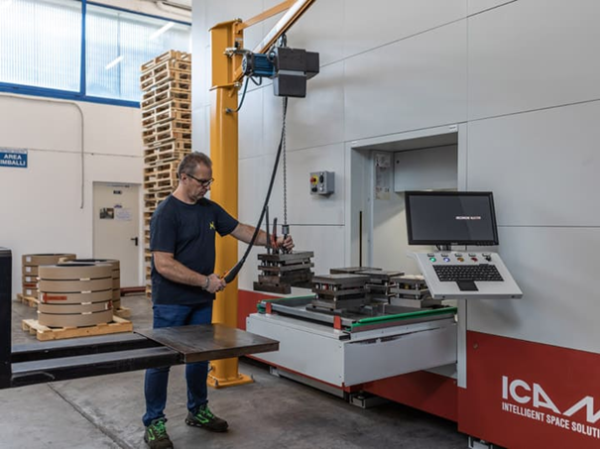
Explore the Moretto Brakes Components user story here >>
7. Real-time software integration for a smarter warehouse
The ICON software, included with every SILO², is fully web-based and natively integrates with ERP, WMS, MES, and logistics systems. Real-time data synchronization allows:
- Accurate inventory tracking and usage reporting
- Synchronized production and logistics planning
- Seamless connection to eCommerce and shipping platforms
This enables predictive maintenance, goods traceability, and process transparency—critical features in regulated or high-throughput sectors like pharmaceuticals, aerospace, and automotive.
8. IRIDE system: fast, guided, error-free picking
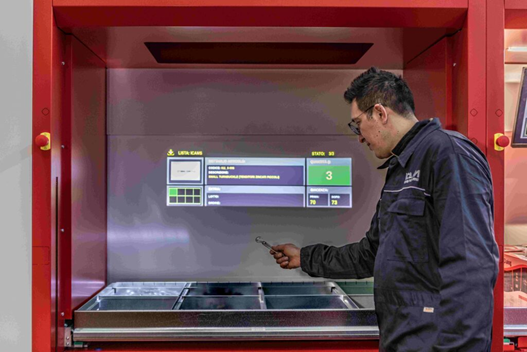
The IRIDE visual assistance system replaces traditional pick-to-light mechanisms with laser-like guidance and projected data directly on the tray.
- Colored light beams indicate material location
- On-tray projections guide the operator step by step
- Outcome: reduced search time, fewer mistakes, faster operator onboarding
This technology improves speed and accuracy, especially useful in fast-paced or high-mix inventory environments.
9. Lower TCO and higher ROI: more value over time
Beyond installation, SILO² delivers long-term operational savings and higher ROI compared to single-column systems.
Why it pays off faster:
- One SILO² can replace 2–3 single-column units, cutting equipment costs
- Shared automation = lower energy consumption
- Simplified maintenance = fewer parts, faster service, less downtime
- Centralized controls reduce training needs and human error
In 2- or 3-shift environments, these benefits add up quickly. Companies reduce total cost of ownership (TCO) while achieving higher throughput per operator and per square meter.
The advantages of multi-column VLM over single-column systems
ICAM’s SILO² multi-column VLM is the ideal solution for businesses with limited space and increasing storage demands. Its modular architecture, outdoor installation options, tailored tray capacity, ergonomic access, and native software integration position it far ahead of single-column alternatives.
With real-world proof from companies like Regie Auto and Pennellificio Bulova, SILO² demonstrates that it’s not just a storage system—it’s an investment in operational efficiency, workplace safety, and digital transformation.
Whether you’re optimizing a production floor or building a future-ready warehouse, the SILO² multi-column VLM is engineered for flexibility, performance, and scalability.