
Manufacturing in 2026: why this decade is different
The year 2026 marks a structural shift for global manufacturing.
Not because of a single disruptive technology, but due to the convergence of forces that are redefining how companies produce, store, and deliver value.
Geopolitical instability, rising input costs, demand volatility, skilled labor shortages, and increasing service expectations are putting pressure on margins while driving operational complexity. In this environment, efficiency alone is no longer enough. Operational resilience has become a strategic requirement.
According to Deloitte’s 2026 Manufacturing Industry Outlook, more than 80% of manufacturing leaders worldwide are redirecting improvement budgets toward smart manufacturing initiatives, with a strong focus on automation, digitalization, and distributed decision-making.

The message is clear: manufacturing in 2026 rewards companies that build adaptive industrial systems, not those that simply optimize isolated processes.
From cost center to critical infrastructure: warehouse automation systems

Within this new paradigm, warehouse automation systems play a central role.
Historically treated as a support function, the warehouse is now emerging as critical infrastructure for production continuity and operational stability.
It is the point where:
- materials and data converge
- planning connects with execution
- production interfaces with the end customer
When warehouse operations lose control, disruptions quickly cascade across the organization.
By contrast, well-designed warehouse automation systems help absorb variability, reduce operational risk exposure, and ensure continuity even under challenging conditions.
Fragile supply chains demand smarter warehouse automation
Recent global disruptions have exposed how vulnerable supply chains can be.
As a result, many manufacturers are rethinking the role of the warehouse: no longer a static buffer, but a dynamic operational system capable of responding to demand shifts, supplier delays, and changes in product mix.
In this context, warehouse automation systems become a key enabler of integrated manufacturing logistics, directly supporting resilience across the entire value chain.
Beyond individual machines: automation as an integrated system architecture
One of the long-standing limitations of industrial automation has been fragmentation: standalone solutions that perform well individually but lack system-level integration.
As Bernard Marr points out in his analysis of manufacturing trends, true competitive advantage comes from the ability to orchestrate technologies, data, and processes, moving beyond isolated automation silos.
Applied to logistics, this means evolving toward integrated warehouse automation systems where:
- warehouse technologies connect natively with ERP and WMS platforms
- inventory and material flow data are available in real time
- operational decisions can be made faster and with greater reliability
Vertical automated solutions, including systems based on Vertical Lift Modules (VLMs), naturally fit into this architecture as scalable, future-ready components.
Digitalizing logistics processes: when data drives operations
Automation and digitalization are not the same.
In manufacturing 2026, digitalization represents the next step: turning daily operations into systems that are measurable, transparent, and continuously improvable.
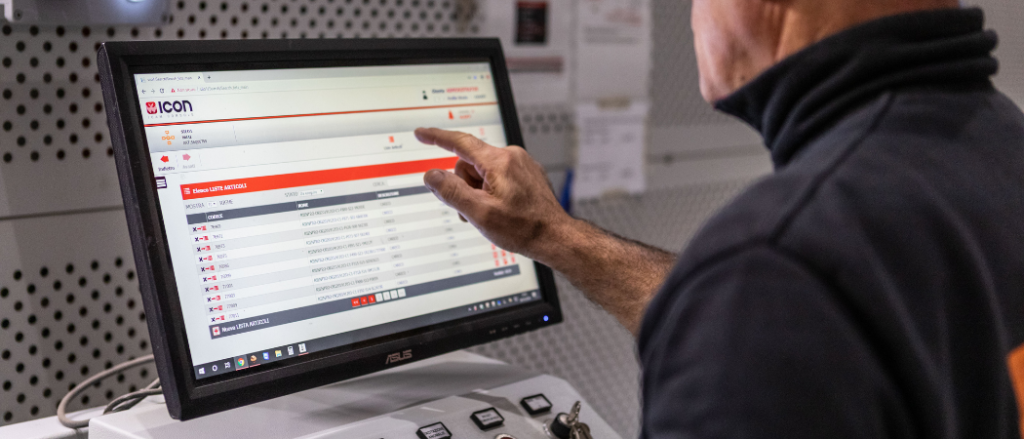
Within warehouse automation environments, this enables manufacturers to:
- maintain real-time visibility into picking and order preparation activities
- dynamically balance workloads and priorities
- anticipate bottlenecks before they impact operations
Logistics process digitalization becomes a decision-making enabler, not just a control layer.
Picking and order fulfillment as indicators of operational maturity
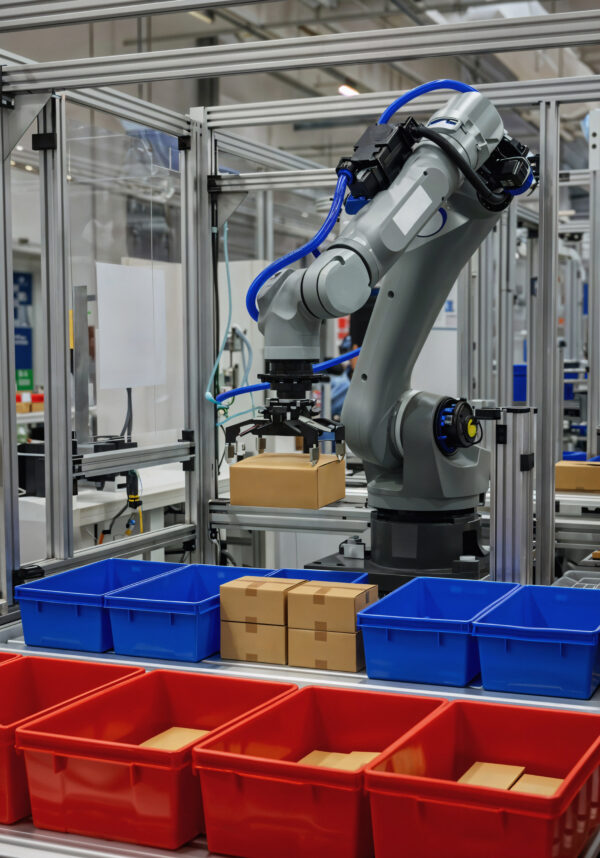
Picking and order fulfillment are among the clearest indicators of operational maturity in manufacturing.
They are labor-intensive processes, often manual, error-prone, and difficult to scale.
By integrating warehouse automation systems with optimized flow design and goods-to-person strategies, manufacturers can:
- reduce operational variability
- improve ergonomics and workplace safety
- increase service quality and order accuracy
In advanced manufacturing environments, these processes are no longer secondary activities, but key performance drivers.
Goods-to-person approaches, commonly used in advanced automated warehouses such as those developed by ICAM, are increasingly becoming an industry standard.
Operational continuity and adaptability: the real ROI of automation
In 2026, the return on investment in automation is no longer measured solely by productivity gains.
It is measured primarily by adaptability.
Rigid systems that are difficult to integrate or modify quickly become constraints.
By contrast, warehouse automation systems designed as modular platforms directly support the stability and resilience of the overall production environment.
As highlighted by EpicFlow, many digital transformation initiatives fail not because of technology limitations, but due to poor integration between processes, people, and systems.
What manufacturers are looking for today
A clear picture emerges from current industry trends.
Manufacturers are looking for:
- modular, scalable automation solutions
- systems that integrate seamlessly with existing operations
- platforms designed to evolve over time
At the same time, they increasingly avoid:
- rigid, closed automation architectures
- projects that are difficult to adapt
- technologies disconnected from operational strategy
How ICAM addresses these challenges
ICAM designs warehouse automation systems to support long-term industrial evolution.
Vertical Lift Modules (VLMs), horizontal automated storage systems, and mobile racking systems are developed as operational platforms, fully integrable into digital manufacturing environments, modular by design, and engineered to adapt over time.
The goal is not simply to automate warehouse operations, but to enable higher levels of control, continuity, and adaptability across manufacturing processes.
Looking beyond 2026
Technology decisions made today will shape how manufacturing organizations operate over the next decade.
Warehouse automation systems are one of the most tangible points where industrial strategy translates into day-to-day operations.
Key Takeaways
- Manufacturing in 2026 requires resilient systems, not just efficient ones
- Warehouse automation systems are becoming critical infrastructure
- Digitalization turns data into actionable operational decisions
- Picking and order fulfillment are key processes to control
- Integration and flexibility define long-term competitiveness
Schedule a demo with an ICAM expert and evaluate the warehouse automation system best suited to your manufacturing operations.