
Warehouse inventory management is one of the most critical operational activities in any company handling physical goods. It directly affects financial reporting, operational continuity, and purchasing decisions. Yet for many organizations, inventory is still a major operational burden: days of manual counting, slowed-down departments, overtime shifts, inevitable errors, and high stress, especially during peak periods such as year-end or summer shutdowns.
ICAM automated storage technologies, including SILO² vertical lift modules, RIGO horizontal automated storage systems, COMPATTA mobile racking solutions, and MAXI VLM for long and heavy materials, have transformed the way inventory operations are managed. What once took days is now completed in hours and, in some cases, in just minutes.

What warehouse inventory is and why it matters
Warehouse inventory is the process of verifying physical stock and reconciling it with data recorded in company systems.
It is essential to:
- close financial statements accurately,
- identify discrepancies,
- plan purchasing activities,
- prevent production stoppages.
Inventory is not just an internal best practice: it is a regulatory requirement. Companies must perform it at least once a year, typically at fiscal year-end. Many organizations go further, performing quarterly checks or adopting advanced methods such as cycle counting, which distributes inventory checks across specific product groups or warehouse areas.
While these approaches reduce discrepancies and improve data accuracy, they still require time, dedicated personnel, and structured processes. In traditional warehouses, the operational burden remains high.
Why manual inventory is so challenging
In facilities using conventional shelving, inventory typically means:
- physically counting every SKU,
- cross-checking data across paper sheets, handheld devices, or spreadsheets,
- stopping warehouse operations to avoid stock movements,
- assigning staff for long counting sessions,
- accepting that errors and inconsistencies are almost unavoidable.
At year-end, when many companies are already under pressure, this often results in delays, overtime costs, and inventory inaccuracies that negatively affect operations in the months that follow.
Manual vs. Automated Inventory: the impact of ICAM automation
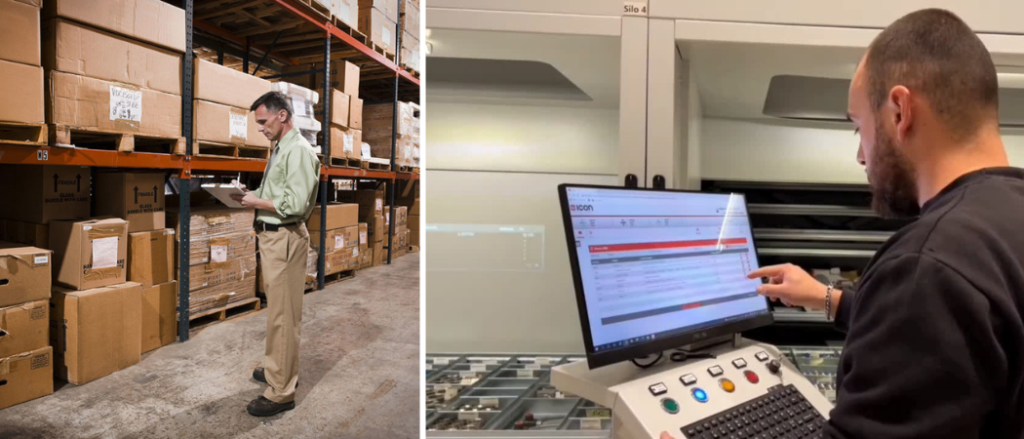
Manual inventory: slow, stressful, error-prone
Companies managing warehouse inventory without automation commonly face:
- materials spread across multiple storage areas,
- lack of fixed storage locations,
- long search times,
- manual data entry errors,
- no real-time stock visibility,
- constant risk of stockouts or overstocking.
Automated inventory: full traceability and faster inventory cycles
With ICAM automated storage systems, inventory is essentially “ready” every day. ICON software records every inbound and outbound movement in real time.
ICAM solutions allow companies to:
- centralize inventory in a compact, protected storage system,
- track every movement digitally,
- know exact stock levels instantly,
- perform inventory checks instantly,
- integrate seamlessly with ERP, WMS, and e-commerce platforms,
- reduce verification time dramatically.
Key benefits of automated warehouse inventory management
1. Inventory time reduced from days to hours
Eliminating manual searching and counting avoids operational downtime and accelerates both full and partial inventory checks.
2. Business continuity
Inventory can be performed without stopping production or logistics, since stock data is already collected automatically.
3. Near-zero errors
ICON removes paper, manual counts, and mismatches between physical and digital inventory.
4. Prevention of stockouts and overstocking
Real-time inventory visibility helps companies:
- avoid production downtime,
- plan purchasing accurately,
- reduce capital tied up in excess inventory.
5. Direct integration with third-party systems
ERP, WMS, MES, and e-commerce integrations provide immediate insight into:
- what is available,
- what is running low,
- when to reorder.
Automated alerts, minimum stock thresholds, and notifications complete the system.
6. Order, safety, and traceability
ICAM automated storage solutions protect materials from dust, damage, and unauthorized access, while keeping everything in a single, secure location.
How automation changes daily operations: three concrete case studies
GLS Cosenza: Secure storage of undelivered parcels and controlled inventory
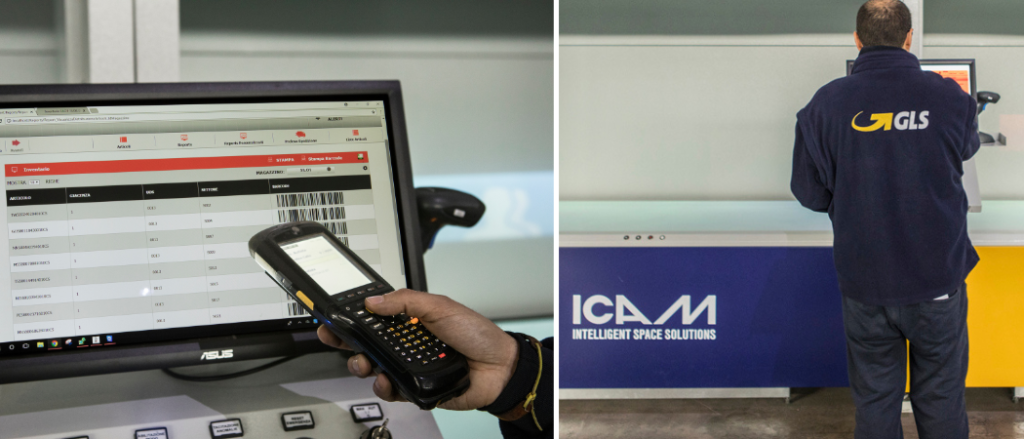
GLS Cosenza manages high volumes of undelivered parcels that must be stored securely, traced accurately, and retrieved quickly. Before automation, these parcels were spread across multiple areas, making inventory checks slow and inefficient.
By installing a SILO² vertical lift module, GLS centralized storage and introduced controlled access and digital traceability.
Alessandro Semprevivo, Owner, explains:
“Thanks to the SILO² system, we reduced labor costs and pickup queues, automated inventory management, and improved security. Goods are now protected from unauthorized access, dust, and dirt.”
The result: faster inventory checks, aligned data, and no operational interruptions.
Esen Fu: SILO² at the core of order fulfillment and real-time inventory
Esen Fu operates in the windows and fixtures sector, managing thousands of SKUs including small hardware, metal components, and accessories used in order assembly. High product variety and fast delivery requirements made inventory control slow and error-prone.
The company installed a SILO² vertical lift module to centrally store high-rotation items, eliminating material dispersion and speeding up picking and verification.
Through integration between SILO², ICON, and the company ERP, every movement is recorded automatically and stock levels update in real time. Inventory, once a time-consuming manual task, is now fast, accurate, and performed without halting operations.
Sales teams also benefit: connected tablets allow real-time stock checks, enabling immediate, reliable responses to customers.
Vito Genchi, CEO of Esen Fu, states:
“Inventory and replenishment are always under control. Thanks to the integration between our ERP and ICON, stock levels are monitored in real time.”
Inventory has shifted from a repetitive burden to a quick, seamless process.
Delizia: One central storage point for spare parts and inventory in minutes
Delizia operates in the dairy industry, where production continuity depends on immediate availability of technical spare parts such as seals, bearings, pipes, and mechanical components.
Before automation, materials were stored across multiple areas on static shelving, making inventory time-consuming and increasing the risk of downtime.
With the installation of a SILO² vertical lift module, all spare parts were centralized in a secure, traceable location. ICON monitors stock levels in real time, reducing both shortages and excess inventory.
Giovanni D’Ambruoso, President, comments:
“Thanks to the SILO² automated storage system, all spare parts are now stored in one secure and organized location. Real-time stock monitoring prevents unnecessary capital lock-up.”
On inventory:
“With just one click, inventory is completed, compared to the hours it used to take.”
The outcome: smoother processes and higher efficiency, even during critical periods.
Warehouse inventory management: FAQ – Frequently Asked Questions
It is the periodic verification of physical stock against data recorded in company systems, essential for financial accuracy and operational continuity.
2. Why is manual inventory problematic?
It is time-consuming, error-prone, and often requires slowing down or stopping warehouse and production activities.
3. Is inventory legally required?
Yes. Companies must perform it at least once a year, typically at fiscal year-end.
4. Are there alternatives to annual inventory?
Yes. Periodic inventories (e.g., quarterly) and cycle counting allow continuous checks throughout the year.
5. How much time can ICAM automated systems save?
From days to hours, and in some cases, from hours to just minutes.
6. Do ICAM systems integrate with ERP and WMS platforms?
Yes. ICON integrates with major ERP, WMS, MES, and e-commerce systems.
7. Which ICAM technologies support automated inventory?
All ICAM storage technologies are supported by ICON, enabling real-time monitoring and automated inventory management.