
Warehouse robotics solutions integrate collaborative robots and intelligent systems to manage the flow of goods, from receiving to storage and shipping. Unlike traditional warehouses, which typically rely on static shelving, these advanced systems significantly reduce the need for manual intervention while increasing operational efficiency.
“In traditional warehouses, material handling and inventory management require extensive manual labor. Operators must search for products, count them, transport them, and pick the correct quantities. In a warehouse equipped with robotics, however, robots handle these operations from pick and place to assembly.”
Smart industry and warehouse robotics: from Industry 4.0 to Industry 5.0
Industry 5.0 takes this concept further by emphasizing human-machine collaboration. The focus is not just on automation but on integrating human skills with advanced machine capabilities.
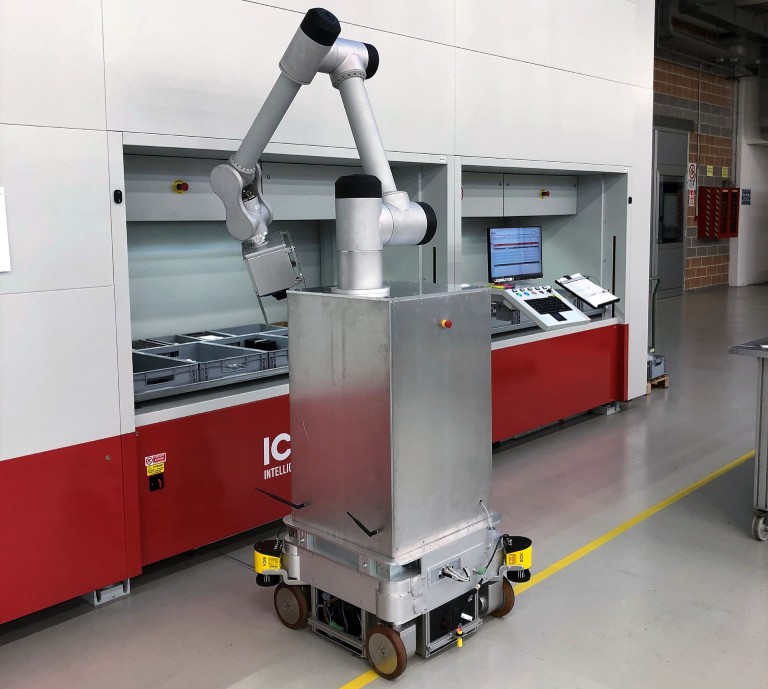
Process automation and human work support
There are various robotic systems for streamlining and making warehouse processes more efficient. Cobots, or collaborative robots, are one of the most innovative and widespread solutions. These robots work alongside human operators and can seamlessly integrate with automated storage solutions such as ICAM’s multi-column SILO² Vertical Lift Module (VLM) and the horizontal multicolumn automated warehouse RIGO system. Cobots efficiently perform single or multiple item picking and refilling tasks.
Warehouse robotics are not designed to replace human labor but to complement it, making operations faster, more accurate, and safer. Cobots can handle dangerous, repetitive, or physically demanding tasks, boosting productivity. By offloading these tasks to robots, warehouse staff can focus on activities requiring creativity, problem-solving, and decision-making.
Additionally, while intelligent systems assist operators with handling tasks, operators play an active role in guiding them. These advanced solutions process real-time data, enabling workers to monitor performance, make timely adjustments, correct inefficiencies, and ensure optimal alignment with operational goals.
The benefits of warehouse robotics
Although the initial investment in robotics may seem significant, the return on investment (ROI) is rapid, and the operational benefits are substantial.
Key advantages include:
- Increased operational efficiency
- Lower operating costs
- Enhanced worker safety
Increased operational efficiency
In robotic warehouses, robots can work non-stop around the clock, allowing them to achieve a high number of picks per hour, ensuring coverage of multiple shifts, and improving speed and accuracy in processing complex orders. This is particularly beneficial in high-throughput sectors like e-commerce, where fast and efficient inventory management is critical. In addition, robotization enables efficient handling of materials that differ in size, weight and value.
Lower operating costs
By reducing order fulfillment errors, warehouse robotics decrease returns, leading to lower reverse logistics costs associated with reprocessing, reshipping, and reintegrating products into the supply chain. These systems follow optimized procedures, ensuring higher inventory accuracy and preventing stockouts or overstocking. Additionally, optimized material movements lower energy costs and mitigate labor shortages.
Enhanced worker safety
Ergonomic material handling, enabled by cobots, improves workplace safety and reduces injury risks. Heavy or bulky load handling is delegated to advanced robotic systems, eliminating physical strain and minimizing workplace hazards. In industrial and warehouse environments where injury rates remain high, warehouse robotics play a crucial role in improving overall safety.
ICAM’s warehouse robotics solutions for smart factories
ICAM is a leading provider of automated storage solutions, helping businesses optimize inventory management and enhance intralogistics operations. Our solutions include SILO² VLMs and RIGO horizontal automated warehouses, which can be integrated with cobots and robotic arms for enhanced benefits.
Each solution is designed with cutting-edge technology to provide real-time, precise control over warehouse operations, tailored to meet customer-specific needs.
Case Study: Benelli Armi, integration of automated storage and collaborative robotics
A prime example of ICAM’s automated storage solutions integrated with collaborative robots is the case of Benelli Armi. At its Urbino headquarters, the Beretta Group company specializing in semi-automatic firearms installed a SILO² automated storage system with two storage columns and two side-by-side picking/refilling stations. One station is operated manually by workers, while the other is fully automated with three collaborative robots assembling kits.
In this setup, the three cobots autonomously prepare assembly kits within the workstation, allowing operators to work safely in the adjacent workstation. This robotic cell eliminated the need for manual kit preparation, delivering significant time and efficiency benefits, including:
- Faster assembly kit preparation, with cobots operating 24/7 in unattended mode
- Higher operational accuracy, with zero error rates
- Increased overall site productivity
For more details, we invite you to discover the success story of Benelli Armi.
The Benelli Armi case: integration between automated warehouse and collaborative robots
Another successful example of warehouse robotics integration is the solution implemented for Bredel, a company specializing in heavy-duty peristaltic pumps, part of the Watson-Marlow Fluid Technology Group (WMFTG).
At its facility in Delden, Netherlands, Bredel integrated a SILO² automated storage system with a portal loader, creating a 24/7 unattended robotic cell for automatic tool changes on CNC machines. This solution enabled Bredel to bring in-house a previously outsourced process, significantly increasing the productivity of its CNC turning and milling center.
Key benefits included:
- Reduced setup times
- Lower material waste
You can explore here the success story of Bredel.
Exploring the future of warehouse robotics with ICAM
Warehouse robotics represent the future of intralogistics, offering substantial advantages in efficiency, accuracy, and safety. The integration of cobots and other robotic solutions with automated storage systems like SILO² allows businesses to stay competitive in an increasingly demanding, digital-driven market.
Discover how automation can transform your warehouse and optimize your logistics operations.