
Fixed shelving or a vertical lift module (VLM)? The difference is how operators access inventory. With fixed shelving, operators go to the storage location. With a VLM, the system brings the materials to the picking and refilling station.
What to consider when choosing a storage system for your business, from floor space and picking efficiency to staffing, quality, and inventory control.
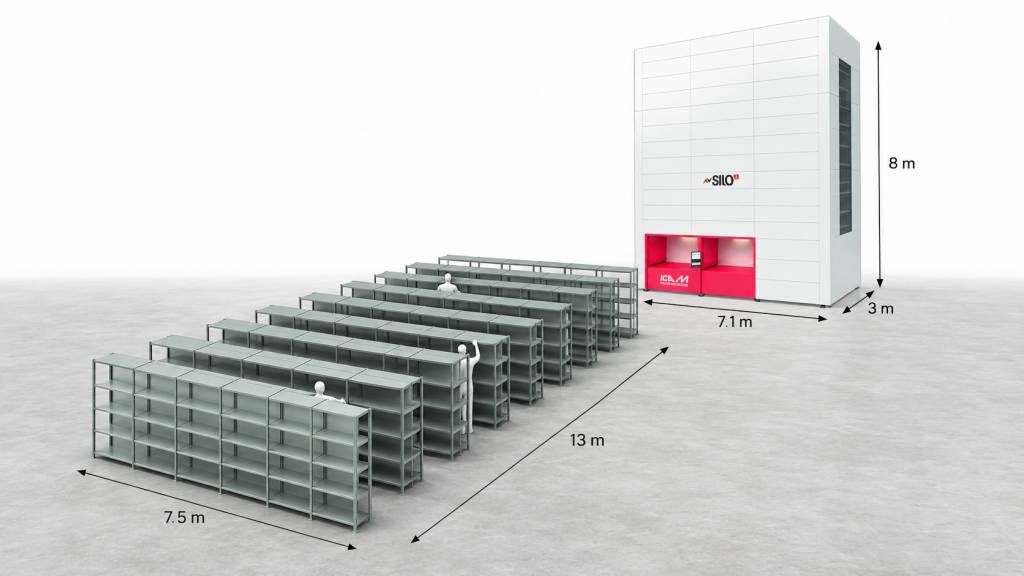
Fixed Shelving or ICAM’s SILO² Vertical Lift Module (VLM)?
The right storage system depends on the loads you handle, your workflows, and your operational goals. This guide compares fixed shelving with tray-based vertical lift modules (VLMs) like ICAM’s SILO² to help you decide when to keep your existing system and when to consider automation.
Fixed shelving or a vertical lift module (VLM)? How operators access materials
Fixed Shelving | Operators go to the materials
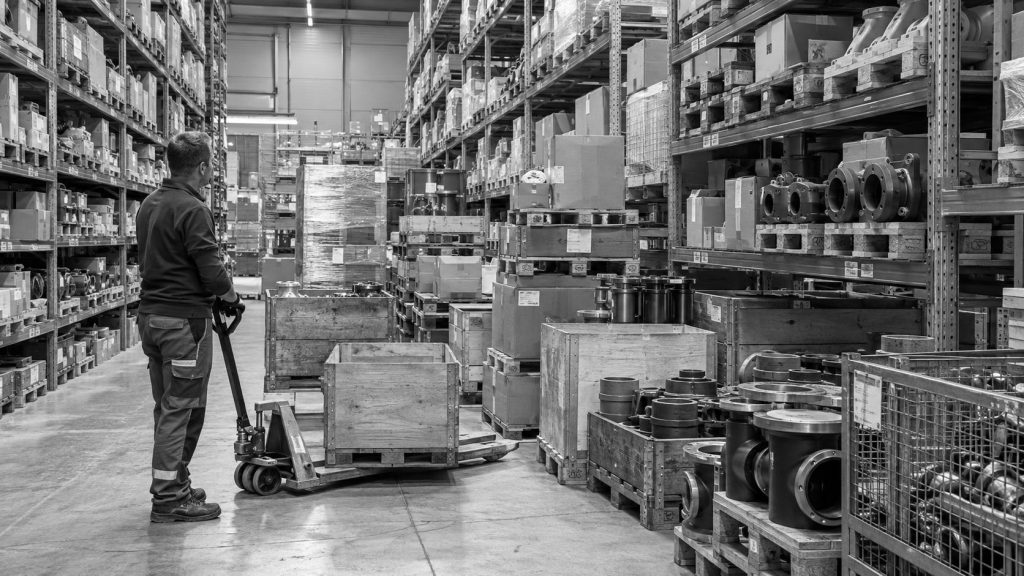
Fixed shelving holds materials on shelves or storage levels along aisles. To pick or put away an item, operators travel to its storage location on foot or using material handling equipment.
This setup provides direct access to storage locations and typically requires a lower upfront investment. Performance depends on the layout, how far operators need to travel, how easily they can access materials, and how daily operations are organized.
Warehouse operations can be managed manually or with a WMS, barcode scanners, and other digital tools. Fixed shelving can support inventory traceability, too.
Vertical Lift Module (VLM) | Materials Come to the Operator
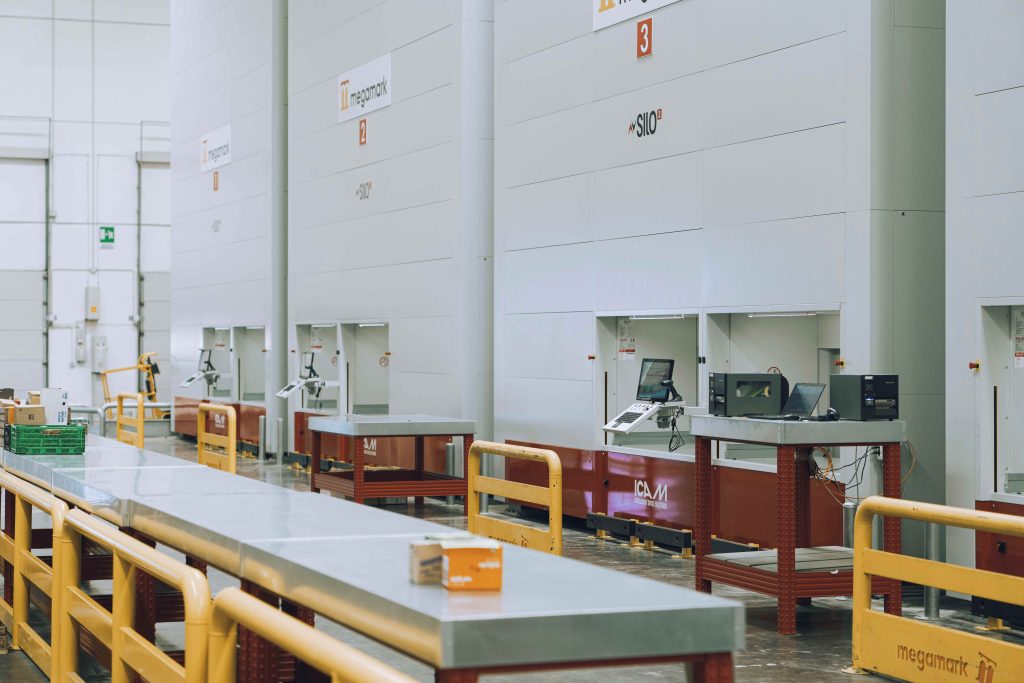
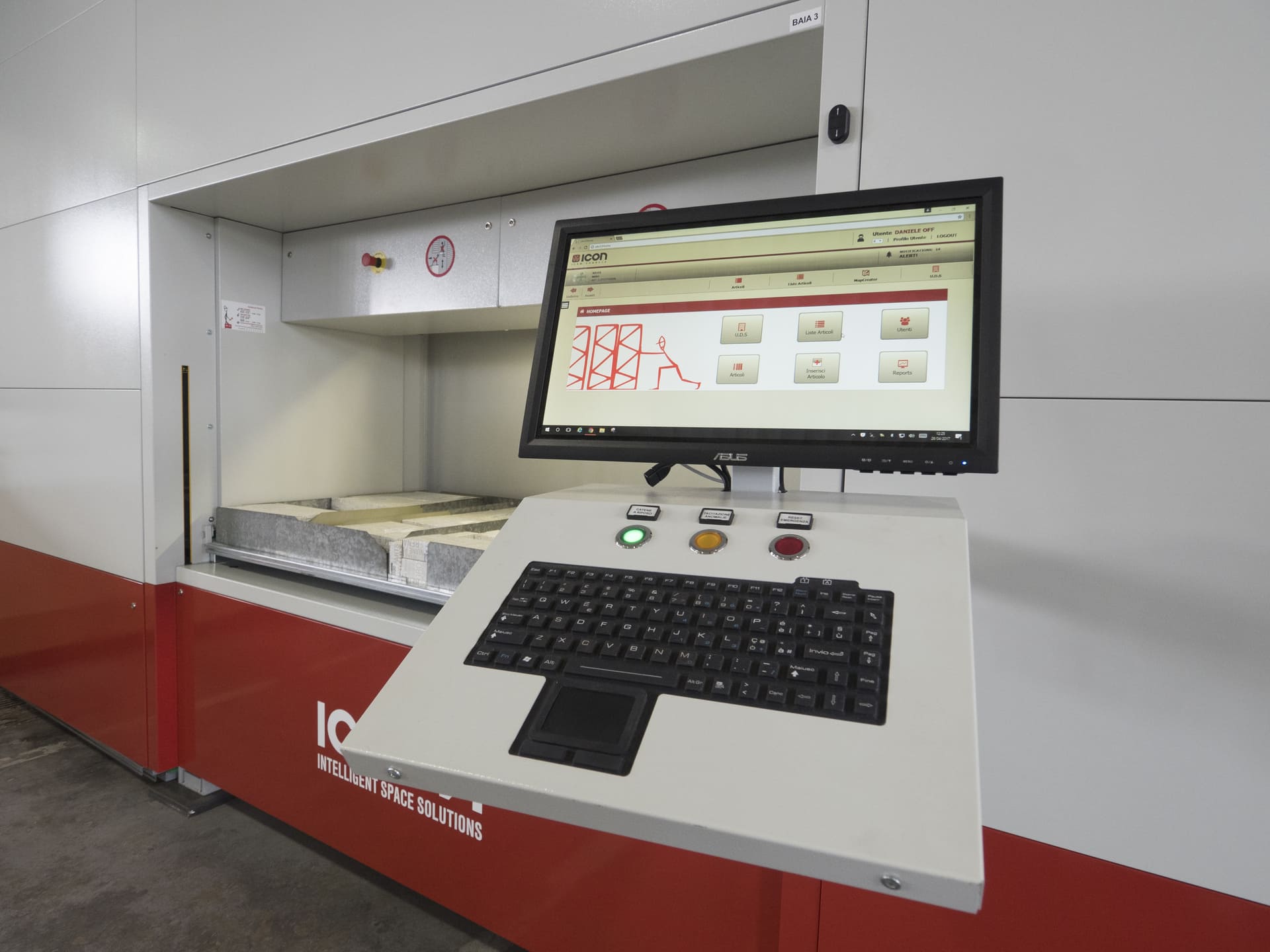
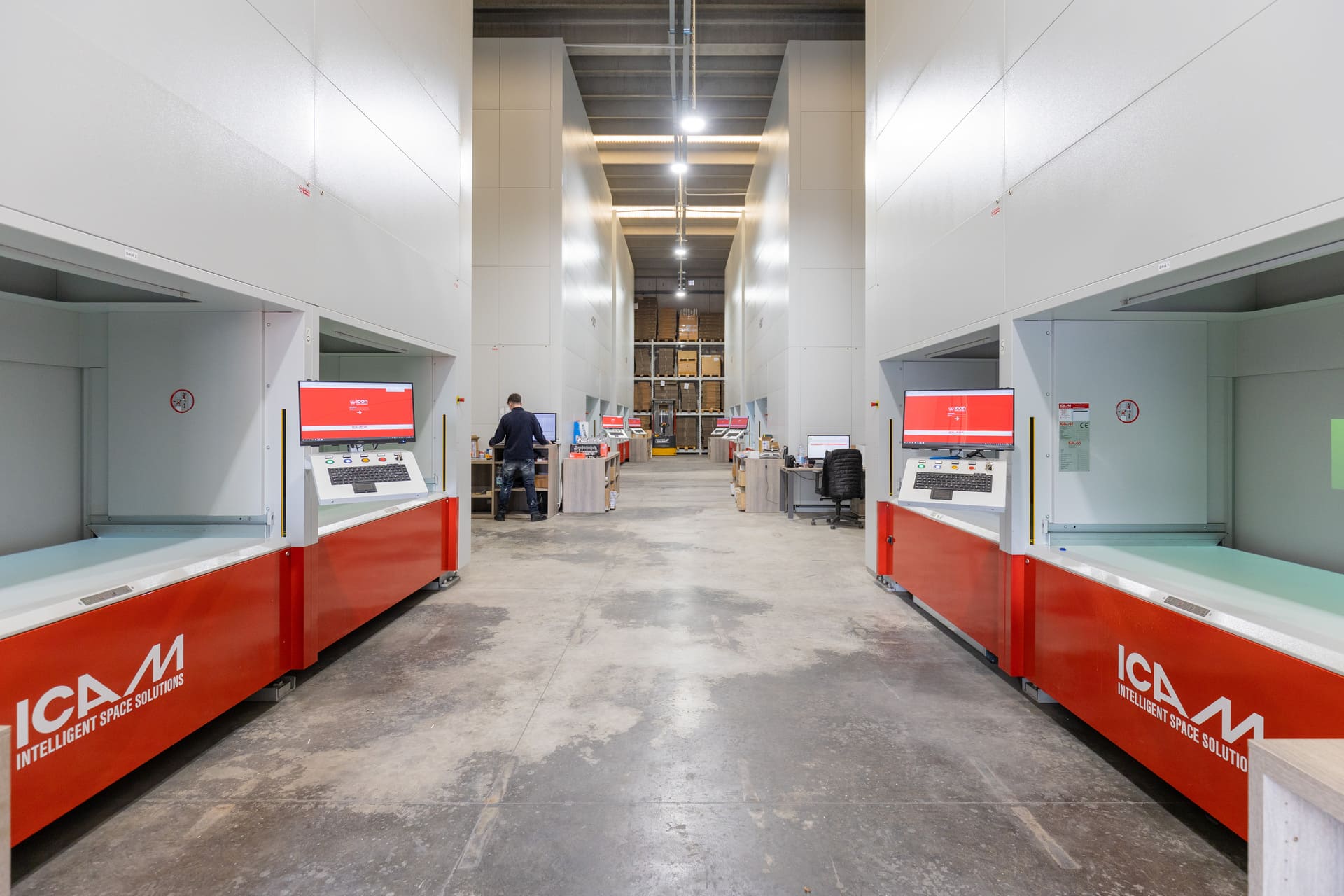
A VLM uses vertical space to store materials. When an operator requests an item, the system retrieves the tray holding it and delivers it to the picking and refilling station.
This is the goods-to-person approach. Operators work in the picking area and spend less time walking to storage locations.
Fixed Shelving or a Vertical Lift Module (VLM)? Six Factors to Consider
1. How much storage space do you need now and in the future?
1. How much storage space do you need today, and how much will you need as your business grows?
A vertical lift module (VLM) uses the available height to store inventory in a smaller footprint. To calculate floor space savings, compare layouts with equivalent storage capacity and service levels, including the picking and refilling stations and the floor space needed to operate them.
ICAM’s SILO² vertical lift module (VLM) can free up 80% of the floor space while storing the same amount of inventory. Actual savings depend on the existing storage system, the materials being stored, and the VLM configuration.
What could you do with the floor space you free up? You could use it to add a production line or improve the flow of materials through your facility.
2. How much time do operators spend searching for items and traveling to storage locations?
Picking starts before an operator retrieves an item. It includes traveling to the storage area, locating the item, verifying its identity, confirming the pick, and moving on to the next one.
With fixed shelving, picking time depends in part on the distance between storage locations and how pick lists are organized. With a vertical lift module (VLM), the system delivers trays directly to the picking and refilling station.
With automation, machine cycle times must match your workflow. Measure performance across an entire order or pick list, accounting for replenishment, peak demand, and the number of operators. Trays moved per hour capture machine throughput, one component of overall picking productivity.
Reducing operator travel time is especially valuable when volumes grow faster than you can add staff and your existing team needs to handle the extra workload.
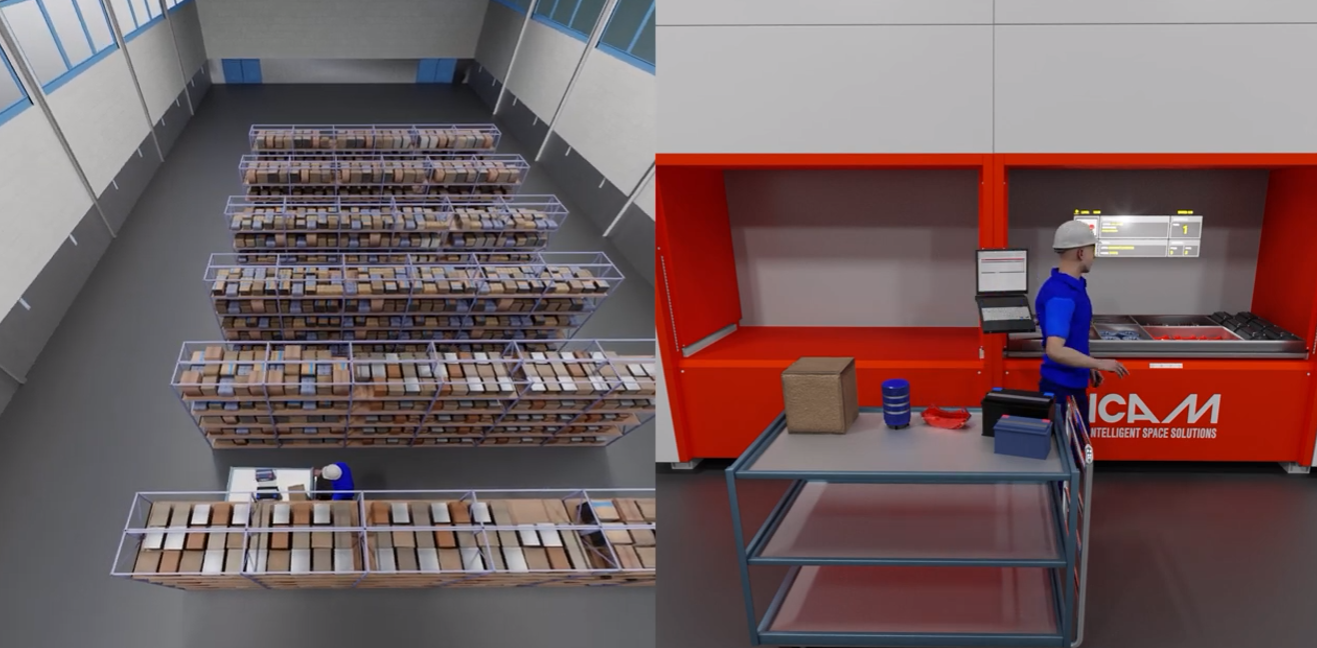
Manual Item Search vs. Retrieval with a Vertical Lift Module (VLM)
3. What does a picking error cost your operation?
The more look-alike items you stock, the more mixed-item orders you fill, and the more pick quantities vary, the more important it becomes to verify that each pick contains the correct item and quantity.
Software and barcode scanners can guide operators through picks from fixed shelving. With a vertical lift module (VLM), the system can deliver the tray to the picking station while a picking guidance device shows the operator which compartment to pick from and how many units to take.
Sui magazzini automatici ICAM, il sistema interattivo IRIDE presente nella baia di prelievo e deposito supporta l’operatore con indicazioni visive e fasci di luce direttamente nella zona di lavoro, rendendo il picking più immediato anche per operatori con poca esperienza.
A picking error can send the wrong component to assembly, lead to an incorrect shipment, or result in a return. Picking accuracy affects process quality and customer service, as well as how much time your team spends correcting errors.
4. How are materials handled?
To assess ergonomics and safety, look at pick heights, load weights, operator posture, travel paths, and the material handling equipment used.
Climbing ladders, accessing mezzanine storage, and repeatedly carrying packages can make picking more physically demanding. A vertical lift module (VLM) brings materials directly to the picking and refilling station, reducing the need for operators to access high or hard-to-reach storage locations.
For molds and other bulky or heavy components, the system design should also account for how items move from the picking station to the next processing step. Evaluate access to the load, extraction devices, and lifting aids together.
Compare the two storage systems across the entire material flow, from receiving to the point of use.
5. How much control do you need over inventory and access to stored materials?
Knowing where an item is stored and whether it’s in stock helps you plan production, purchasing, and shipping. You can manage this information digitally with both fixed shelving and automated storage systems.
In a vertical lift module (VLM), the software also coordinates tray movement, tracks inventory, and alerts operators when stock needs to be replenished. ICON, ICAM’s software for automated storage systems, connects inventory management with machine operations. Available features depend on your operational needs and the ICON package you choose.
Integrating automated storage software with an ERP or WMS eliminates manual steps when the systems are configured to exchange orders and transaction confirmations.
Inventory control also means securing items such as tools, molds, and critical spare parts. ICAM automated storage systems protect these materials within an enclosed structure and use authentication and user permissions to control who can access them. Transaction logs provide a history of item movements and keep track of stock levels.
6. Which storage system will best support your future operations?
Consider how your volumes, product mix, shift schedules, and the departments you serve are likely to change.
A system that can hold your current inventory may struggle to keep up during projected peaks. An oversized system can tie up resources without delivering enough value to justify the investment.
When planning the system, assess spare storage capacity, how easily storage locations can be reorganized, whether multiple operators can access materials at the same time, and how the system will fit into downstream workflows. For automated systems, also factor in operator training, maintenance, and technical support to keep operations running.
When to keep your fixed shelving
– You have enough storage capacity, and operators can easily access the materials they need.
– Operators spend relatively little time traveling to storage locations and searching for items.
– Your layout can accommodate projected growth.
– Your equipment and procedures are suited to the loads you handle.
– The expected benefits of automation don’t justify the investment.
Before switching systems, consider reorganizing storage locations, improving how items are identified, and refining the sequence of picks on each list. If the main issues are with data or procedures, you’ll still need to address them after installing an automated storage system.
When to consider a Vertical Lift Module (VLM)
– Floor space is limited, but you have vertical space available.
– Operators spend too much time searching for items and walking between storage locations.
– Volumes are growing faster than you can add staff.
– Picking errors cause delays, returns, or rework.
– Production or maintenance teams have to wait for materials that are hard to locate.
– You need to secure critical items and control who can access them.
– You need to keep the inventory records in your business systems in sync with what’s physically in stock.
Fixed Shelving or a Vertical Lift Module (VLM)? A side-by-side comparison
| Factor | Fixed shelving | Vertical Lift Module |
| Access to materials | The operator travels to the storage location on foot or using material handling equipment. | The automated system delivers the tray to the picking and refilling station. |
Space Utilization | Shelving, aisles, and access points are spread throughout the layout. | Inventory is stored vertically, with integrated picking and refilling stations. |
| Picking Time | Picking time depends in part on how long operators spend searching for items and traveling between storage locations. | Picking time depends on machine cycle times, tray locations, and how pick lists are organized. |
| Picking Accuracy | Software and barcode verification can help improve picking accuracy. | Tray delivery can be paired with picking guidance and digital pick confirmations. |
| Inventory Traceability | Manual or digital tracking, including through a WMS. | Digital inventory tracking integrated with automated tray movement. |
| Ergonomics | Depends on the layout, pick heights, and the use of material handling equipment, ladders, and other aids. | Operators access materials at picking and refilling stations set at an ergonomic working height. |
| Storage Security | Stored materials are accessible to anyone in the storage area. | Enclosed storage with access controls that vary by system configuration. |
| Operational Continuity | Depends on staffing, access to materials, handling equipment, and operating procedures. | Also requires machine maintenance and technical support. |
| Investment | Typically a lower upfront cost. | Weigh the upfront investment against long-term costs and benefits. Typical payback period: 12–18 months. |
Can I automate just part of my warehouse?
Yes. Fixed shelving and vertical lift modules (VLMs) can operate side by side. You can automate storage for the item groups that benefit most and keep other materials on fixed shelving.
When deciding what to store in each area, consider item dimensions, weight, picking frequency, and how critical each item is to your operations. Also account for how stock moves between areas during replenishment.
Depending on the features you use, ICON can coordinate operations across ICAM automated storage systems and conventional storage areas. Keeping inventory information consistent across those areas is just as important as how you physically organize the materials.
Choosing the right storage system starts with your warehouse data
To compare your options, gather the following information:
- Fixed shelving or ICAM’s SILO² Vertical Lift Module (VLM)?
- Picking and replenishment data, including peak volumes.
- An inventory list with item quantities, dimensions, and weights.
- Picking errors and the work required to correct them.Your facility layout, available height, and the departments the storage system needs to serve.
- Available resources and growth goals.
This snapshot of your warehouse operations helps you determine how much automation makes sense and how to integrate it into your existing workflows.
Frequently Asked Questions
Yes. You can start with one vertical lift module (VLM) for selected product families and keep the rest on fixed shelving. Decide which items go in each storage area, how stock will be replenished, and how inventory data will be managed so both areas operate as part of the same workflow.
Yes. A WMS can manage storage locations and operations in fixed shelving areas. An automated storage system builds on digital inventory management and continuous tracking by controlling the movement of materials to picking and refilling stations.
A vertical lift module (VLM) can reduce the time operators spend searching for items, walking between storage locations, and handling trays. Depending on the project, this can help you handle the same workload with fewer operators or process higher volumes with your existing team.
Yes. A vertical lift module (VLM) brings the tray containing the requested item to the picking station. Interactive picking guidance and confirmation prompts help operators verify they’re picking the correct item and quantity. In ICAM automated storage systems, IRIDE provides visual picking guidance to help eliminate picking errors.
ICAM’s SILO² vertical lift module (VLM) can reduce the floor space needed to store the same inventory by 80%. Actual savings depend on your current layout, materials, and system configuration. Compare layouts at the same storage capacity and service level, including picking and refilling stations and the space needed to operate them.
confronto deve includere spazio, tempi, errori e risorse disponibili. No. The right choice depends on your operational needs and whether the expected benefits justify the investment. Fixed shelving can still be a good fit if it provides the storage capacity, access, and organization your team needs. Compare both options based on floor space, time spent on warehouse tasks, error rates, and available resources.
Wondering if it’s time to switch from fixed shelving to a vertical lift module (VLM)? Let’s talk.
We’ll look at your workflows, available space, and operational goals to help you choose the right storage system.
You may also be interested in
Regie Auto | 10% Higher B2B Sales and 200 m² of Floor Space Freed Up with SILO²
See how a SILO² vertical lift module (VLM) serves both the parts center and the service shop while freeing up about 200 m² of floor space.

FT chooses the SILO² Vertical Lift Module (VLM) for tool distribution
See how FT cut order fulfillment times by 67% and eliminated picking errors.
How much does a Vertical Lift Module (VLM) Cost? A guide to Total Cost of Ownership
Find out what to look for in a vertical lift module (VLM) quote, from the purchase price to the long-term costs of ownership.