
How much does a vertical lift module (VLM) cost? The honest answer is: it depends on height, width, depth, load capacity and the level of automation required, and anyone searching for this answer can already find figures published by several manufacturers.
The more useful question, though, is different: does that initial price represent the real cost of the investment, or just its starting point?
In our experience, the real cost of a vertical lift module is measured over years, not on the day the order is placed, and that is where genuinely cost-effective configurations separate from ones that only look affordable upfront.
Let’s start with the basics: a vertical lift module (VLM) is an automated storage system that brings items directly to the operator, reducing travel time and floor space requirements. Its cost depends on several factors.
What determines the price of a vertical lift module?
Before looking at total cost of ownership, let’s break down what drives the purchase price of a vertical lift module, the starting point for evaluating any investment:
- System dimensions, storage capacity, and load capacity: height, width, and depth determine the system’s footprint, available storage capacity, and the number of trays it can accommodate. The system’s maximum total load capacity also affects its structural design. Together, these factors help determine the price of an automated storage system.
- Number and type of picking and refilling stations: a single station lowers the upfront cost but limits throughput as operational demands grow. Multiple stations, particularly side-by-side stations, speed up picking, while stations on opposite sides or at different floor levels allow the same automated storage system to serve different areas of the facility.
- Level of picking automation: from conventional pick-to-light systems to advanced interactive picking guidance systems such as ICAM’s IRIDE, each additional level of operator assistance affects the price of a vertical lift module. It also affects performance: in ICAM’s project for Graziano sas, IRIDE helped double picking productivity, from 60 to 120 picks per hour per operator, with 12 orders prepared simultaneously and zero picking errors.
- VLM management software: the quote should clearly specify which software packages, interfaces, and configuration services are included, and whether the license requires a one-time payment at activation or recurring fees.
- Seismic design: seismic risk at the installation site, along with system loads and configuration, may require structural reinforcement that affects the price. For installations in Italy, ICAM vertical automated storage systems include a seismic assessment as standard, accounting for local site and ground conditions in accordance with applicable Italian workplace safety requirements (Legislative Decree 81/2008).
- Installation and technical support: shipping, site preparation, assembly, testing, and startup all contribute to the upfront cost of a vertical lift module.
Several manufacturers publish pricing guidance based on these factors. From what we have seen, advertised prices for a basic configuration – a VLM with a single picking and refilling station – can be in the tens of thousands of euros. This provides a useful starting point, but it is important to check what is included. Management software licensing, technical support, installation, and, depending on the project, integration with existing business systems may be quoted separately. Across suppliers, the advertised price of the machine alone rarely reflects the full investment cost.
Why the list price doesn’t tell the whole story: total cost of ownership (TCO)
The purchase price is just one part of the lifetime cost of a vertical lift module.
Total cost of ownership (TCO) also includes:
- Software licensing and system integration costs should also be factored in. Licenses may require a one-time payment or recurring fees. The ease with which the software integrates with ERP, WMS, and other business platforms also affects the total cost. Automated data exchange reduces manual data entry and errors and makes it easier to adapt workflows as operational needs change.
- Time to full operation: the time between VLM installation and full operational readiness. Each week of delay in integrating the system with existing business platforms or properly loading materials onto trays adds indirect costs that are rarely factored into the initial comparison of quotes. Loading guides provided by the VLM supplier can simplify the initial loading process, but not all suppliers offer these resources.
- Maintenance and technical support throughout the system’s operating life. Service coverage, guaranteed response times, and scheduled inspections all affect ongoing costs.
- Digital services help maintain system efficiency. Reports and data analysis support day-to-day operations and identify opportunities for improvement, such as reorganizing items on trays based on picking frequency or which items are frequently picked together. More efficient item placement reduces VLM movements and waiting times, helping lower energy consumption and wear while making full use of the available storage capacity.
Two configurations with the same list price can have very different total ownership costs over five or ten years. Much depends on how well each system is designed to maintain its efficiency as operational needs change, beyond its performance on day one.
The ICAM approach: managing long-term costs through modularity and a one-time software license fee
At ICAM, we look beyond the upfront price of a vertical lift module to ask what it will cost to keep the system running efficiently three, five, or ten years from now.
This principle is at the heart of the ICAM Journey: every automated storage system we install marks the beginning of a relationship, not the end of a project. Our vertical storage systems are configured to meet specific requirements and designed to adapt as operational needs change. We continue to develop new options and features that can also be added to systems already in operation.
The ICAM approach offers three practical ways to manage the long-term cost of a vertical lift module:
- 1. Modular configuration. We start with your actual operations, considering workflows, inventory turnover, item types, and volumes, to size the investment around what you need. This avoids oversizing and tying up capital in unused capacity, while delivering a configuration that meets the project’s requirements without the compromises of adapting a predefined model.
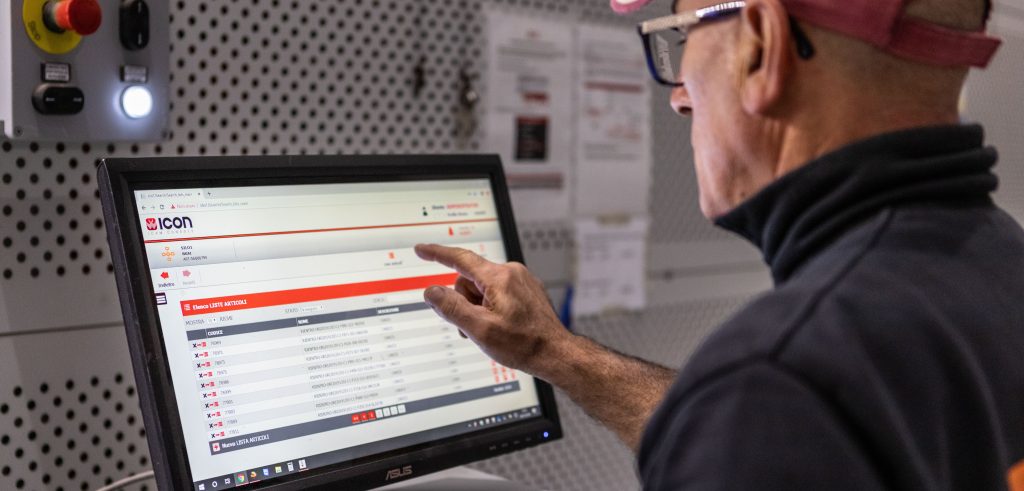
2. A perpetual software license with a one-time fee. ICON, our proprietary management software for ICAM automated storage systems, connects the system to ERP, WMS, and MES platforms, making every operation traceable and measurable. The ICON license is perpetual, with no recurring license fee. This is an important point to check when comparing suppliers, as even a modest recurring software fee can add substantially to total cost of ownership over five to ten years.
3. Quick Start included in all software packages. ICON, the management software for ICAM automated storage systems, includes Quick Start, which handles much of the integration work with existing business systems during initial configuration. Completing this work early, rather than as a separate task after installation, shortens the time to full operation and reduces the associated indirect costs discussed above.
Another benefit is often overlooked when evaluating quotes: if your company already uses a WMS, ICON Zero, included as standard in every ICAM automated storage system, is all you need. Its tray-level ABC classification automatically repositions the most frequently accessed trays closer to the picking and refilling stations, reducing picking times by up to 30%. This shows how software, alongside hardware, contributes to the return on investment over time.
Our commitment continues after installation through technical support, software updates, and ongoing operational guidance. As we say in the ICAM Journey, installation marks the start of our day-to-day responsibility to support your operations.
A practical example is ICAM’s project for FT SpA, a leading Italian B2B distributor of tools and safety equipment for the construction industry. Four SILO² VLMs arranged in two facing pairs form a single pod of machines occupying just 92 m², where operators manage the entire catalog of small parts, accessories, and tools, totaling approximately 1,700 SKUs. The result: order processing time reduced by 67%, from 45 to 15 minutes per order, and 99% fewer picking errors.
How to evaluate a vertical lift module quote
When comparing quotes from different manufacturers, ask these questions to check whether the offers cover the same scope:
- Does the quoted price include the storage management software, or is it priced separately?
- Is the software license a one-time purchase, or does it require a recurring annual or monthly fee?
- If your volumes or product mix change in two years, what would it cost to adapt the system? Would you need an expansion, a separate installation, or a replacement?
- Is technical support included after installation, for how long, and what exactly does it cover?
- Is integration with existing business systems part of the initial configuration, or is it a separate task—and cost—to be addressed after installation?
Answering these questions before placing an order is often more useful than simply comparing the bottom-line prices.
What does a vertical lift module really cost over its lifetime?
Configurability, software costs, maintenance, future upgrades, and ongoing technical support and digital services all have at least as much impact on a vertical storage system’s total cost of ownership as its purchase price.
The purchase price of a vertical lift module is therefore just the starting point of a cost calculation that spans years of operation.
When comparing quotes, look beyond the purchase price and consider what it will cost to keep the system running efficiently over time.
FAQ – Frequently asked questions
The price of a VLM depends on the system’s dimensions, the number and load capacity, the picking and refilling stations, and the software. To establish the full investment cost, the quotation should also specify transport, installation, training, and integration with existing business systems.
Higher load capacities, additional picking and refilling stations, picking guidance systems, and software integrations all affect the price of a vertical lift module. When comparing quotations, check that they cover equivalent storage capacity, features, and operating performance.
Software may be included in the price of a VLM or quoted separately, so check the quote to confirm which features and integrations are included. ICAM automated storage systems include ICON Zero firmware as standard, while ICON Basic and Pro are available with a perpetual license for a one-time fee.
After purchasing a vertical lift module, factor in maintenance, technical support, energy costs, and any recurring software fees. To estimate the total cost of ownership, add these expenses to the purchase price over a defined period, such as five or ten years.
The estimated payback period for an ICAM SILO² vertical lift module (VLM) is typically 12 to 18 months. The actual timeframe depends on the initial investment—including the selected configuration and options—as well as throughput, space savings, reductions in labor time and errors, and operating costs. Payback should therefore be calculated using the company’s actual operating data and the specific system purchased.
A used VLM generally costs less to purchase than a new one. When comparing quotes, also factor in dismantling, shipping, and reinstallation costs, as well as the system’s condition, spare parts availability, and software compatibility.
Which VLM configuration and total cost of ownership make sense for your operation? Let’s talk.
Discover how we support and adapt your system as your needs evolve: your ICAM Journey.
You may also be interested in
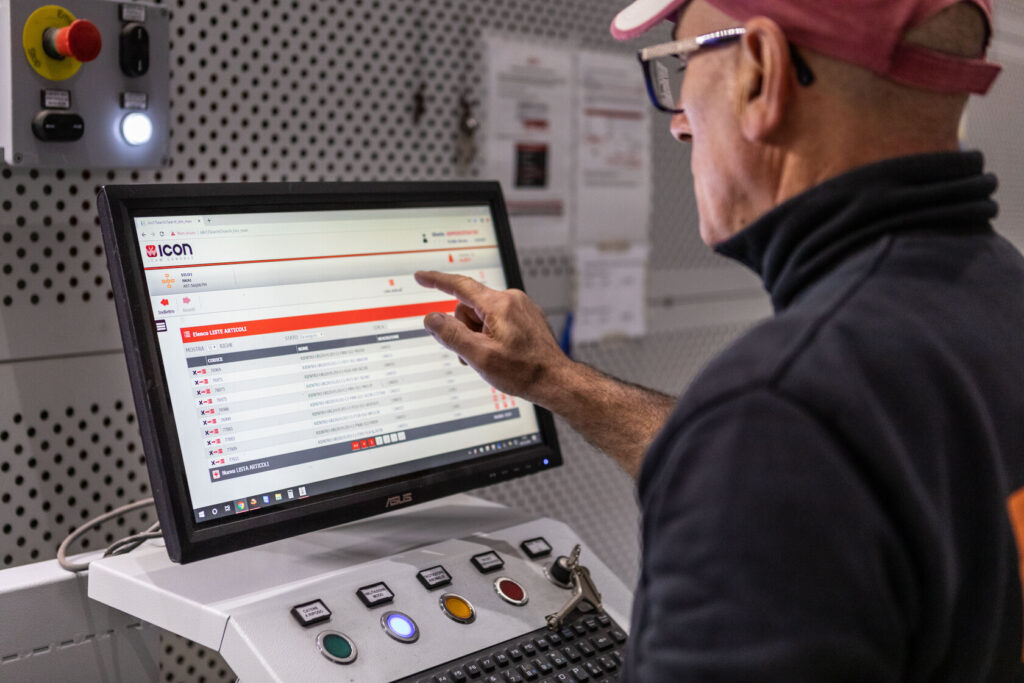
ICON: ICAM storage management software with a perpetual license and business system integration
Explore the three ways ICON, ICAM’s storage management software, integrates with ERP, WMS, and MES platforms.
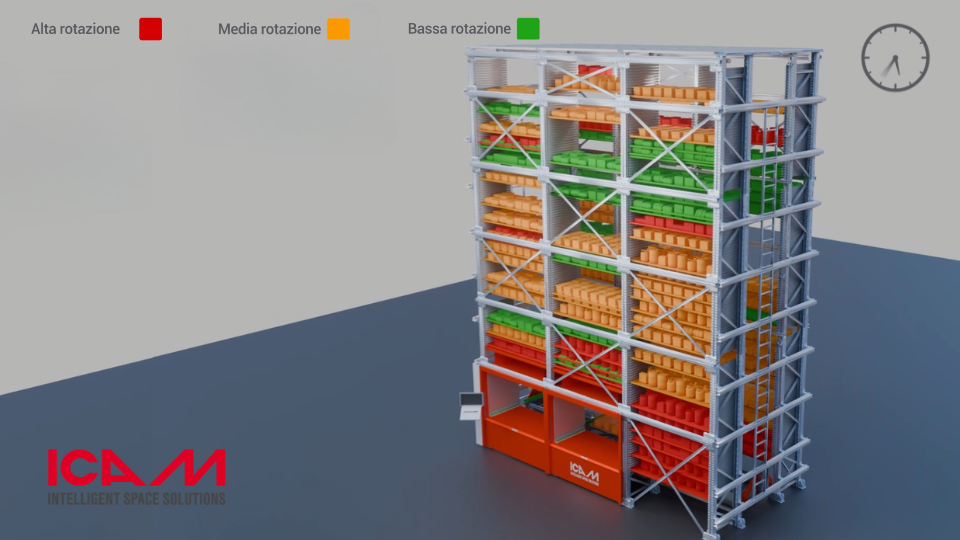
ABC classification in ICON: tray-level and item-level features across software packages
Learn how ABC classification can reduce picking times by up to 30%.
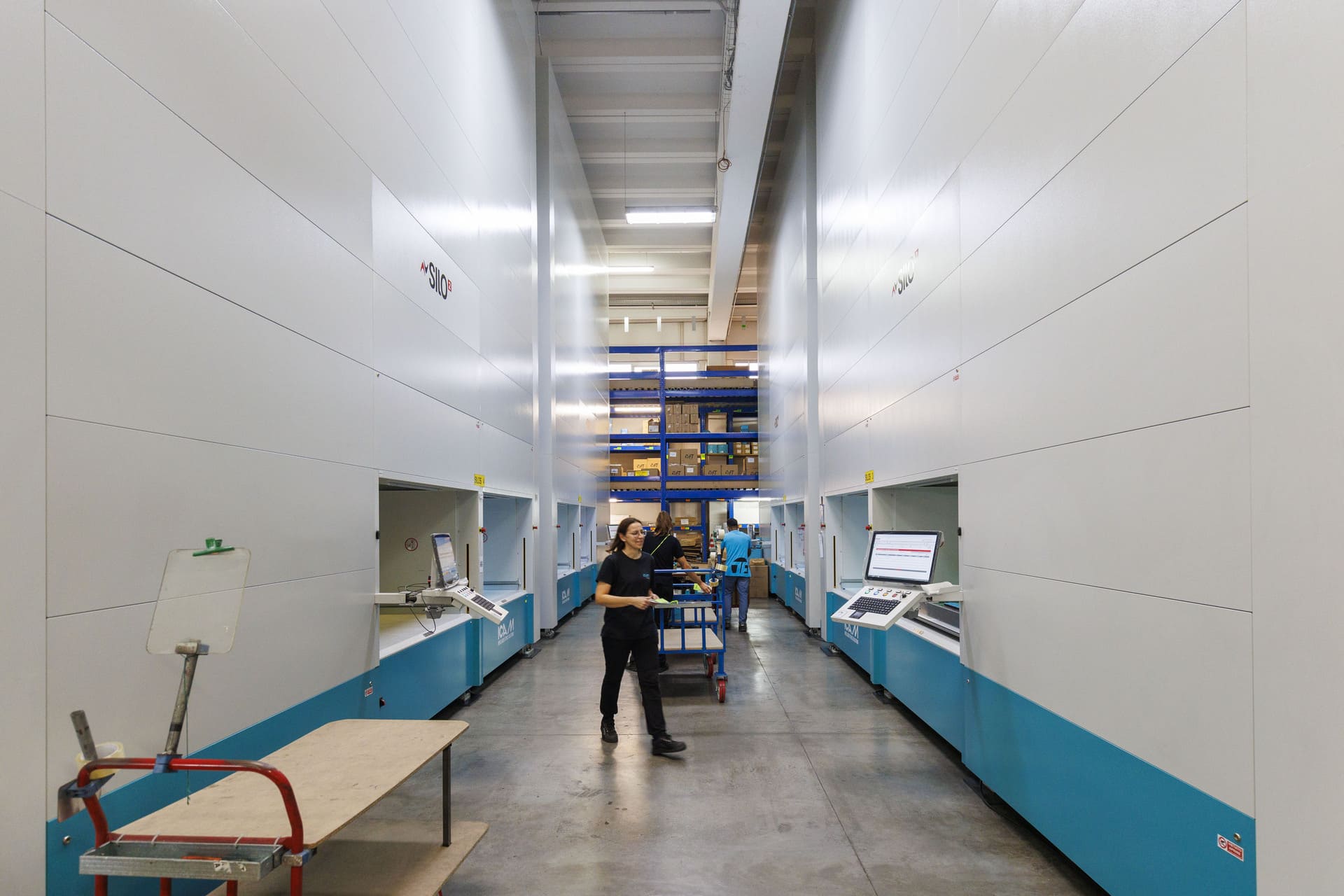
FT SpA case study: four SILO² VLMs for construction tool distribution
See how FT improved warehouse performance, cutting order processing times by 67% and picking errors by 99%.